
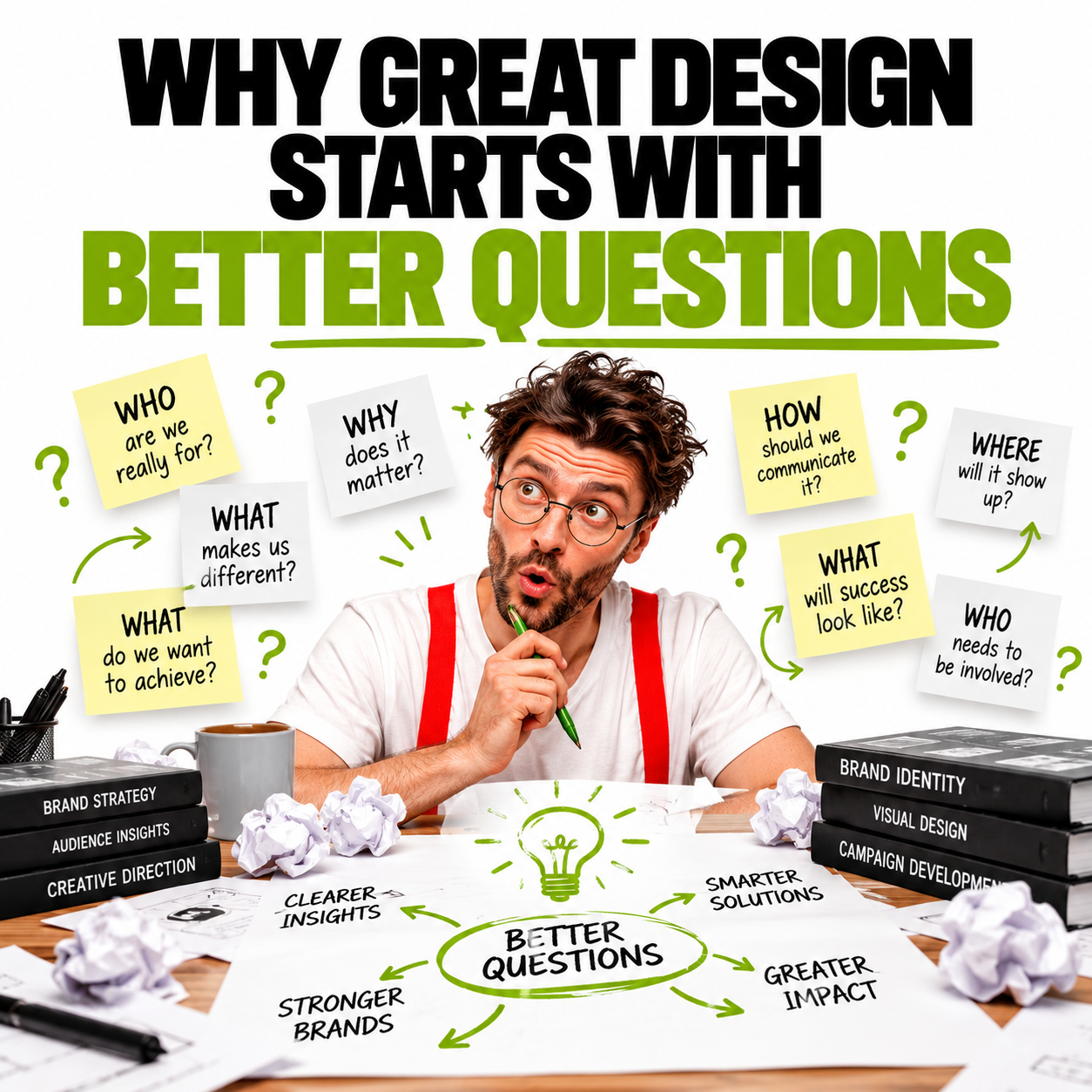
Many people believe great design begins with a creative idea.
But even the strongest idea needs a clear purpose.
Long before the first sketch, the first colour palette, or the first design file, someone needs to ask a better question.
Not:
“Can you design us a logo?”
But:
“Why does our business need one?”
That single question can change the entire direction of a project.
Great design rarely begins with better software. It begins with better questions. Before We Design, We Define.
Most design requests are solution requests
Businesses often approach a creative agency with a clear idea of what they want:
- A logo
- A website
- A brochure
- A company profile
- A social media campaign
These are reasonable requests. But they are requests for deliverables, not definitions of the underlying problem.
A business may ask for a new website when prospective customers are actually confused about its positioning.
It may request a brochure when the real issue is an unclear value proposition.
It may commission a new logo when trust — not recognition — is the greater obstacle.
If the real problem remains undefined, even a beautifully executed solution can miss the point. Design should respond to the problem, not simply reproduce the request.
Design begins with purpose, not appearance
It is tempting to begin by asking:
“What should this look like?”
But a more useful question comes first:
“What should this achieve?”
The difference appears subtle. In practice, it changes the entire conversation.
One begins with aesthetics. The other begins with purpose. When the desired outcome is clear, decisions about identity, messaging, content, channels, and visual expression become more focused. Design stops being decoration and becomes a tool for communication, trust, and business performance.
Better questions create better briefs
Before discussing colours, typography, or layouts, organisations should explore questions such as:
- What business problem are we trying to solve?
- What has changed?
- What happens if nothing changes?
- Who needs to understand or believe this?
- What perception needs to change?
- What should never change?
- Why do customers choose us today?
- Why do some customers choose someone else?
- What would a successful outcome look like?
These may not sound like design questions. They are business questions — and that is precisely why they matter.
The answers shape the brief. The brief guides the strategy. The strategy gives every creative decision a reason to exist.
From strategy to execution
At JAB Design, we see creative work as the result of a sequence of decisions, not a single moment of inspiration.
Define:
- Business strategy
- Positioning
- Messaging
Execute:
- Creative direction
- AI-assisted execution
- Content and design outputs
Strategy defines. AI accelerates.
Technology can help teams explore, produce, and refine work faster. It cannot decide what a business should stand for, what an audience needs to understand, or which problem deserves to be solved.
AI can accelerate execution. Strategic judgement must still set the direction.
Great briefs describe outcomes, not deliverables
Consider these two briefs.
Brief One:
“We need a new website.”
Brief Two:
“Prospective clients do not understand our value within the first minute.”
The first names a deliverable.
The second identifies a communication problem.
A new website may still be part of the answer. But the stronger brief opens the door to a more effective solution: clearer positioning, sharper messaging, a better content hierarchy, and a more purposeful customer journey.
When a brief defines the outcome, the design team can evaluate ideas against something more meaningful than personal preference.
The cost of solving the wrong problem
Organisations can spend significant time and money improving the wrong thing.
A beautiful annual report cannot compensate for unclear messaging.
A modern logo cannot fix weak positioning.
A new website cannot repair a confused customer experience on its own.
When diagnosis is skipped, businesses often enter a costly cycle: redesign, launch, disappointment, and redesign again. Good design improves communication. It cannot rescue a strategy that has never been clarified.
Listening is part of the design process
Many people assume design begins when visible creative work starts.
We believe it begins much earlier.
It begins by listening — to leadership, internal teams, customers, and the market. It also means paying attention to the gaps: what stakeholders assume, what customers misunderstand, and what no one has yet articulated clearly.
This discovery process is not a delay before the “real work”. It is part of the real work.
Only after the context is understood can creative decisions be made with confidence.
Sometimes design is not the first answer
Occasionally, the most responsible recommendation is not to design anything yet.
The business may first need strategic alignment. It may need clearer positioning, stronger messaging, or better internal agreement about its priorities.
Starting production before resolving those issues usually creates more revisions, more opinions, and more waste.
Good advice is not measured by how much design is produced. It is measured by whether the right problem is solved.
Before We Design, We Define.
Technology has changed. Design software has evolved. Artificial intelligence has entered the creative process.
One principle remains constant: better outcomes begin with better questions.
That is why every meaningful project at JAB Design begins with understanding before execution.
We clarify the challenge, define the outcome, and establish the strategic direction before deciding what should be designed.
Before We Design, We Define.
Frequently asked questions
Why are questions important in the design process?
Questions reveal the business problem, audience needs, constraints, and desired outcome behind a design request. This gives the creative team a clearer basis for making effective decisions.
What makes a good creative brief?
A good creative brief explains the challenge, audience, context, desired change, measures of success, and relevant constraints. It should define what the work needs to achieve, not only what needs to be produced.
What is the difference between design and strategic design?
All effective design involves creative thinking and problem-solving. Strategic design places particular emphasis on connecting those decisions to broader business objectives, brand positioning, and communication outcomes.
Can AI replace design strategy?
AI can accelerate research, exploration, and production, but it cannot independently determine the right business direction. Strategic judgement is still needed to define the problem, assess context, and choose what matters.
When should a business engage a design agency?
A business should engage a design agency when it needs an objective partner to clarify a communication challenge, strengthen its positioning, or translate strategy into an effective identity, experience, or campaign.
Final thoughts
Great design is not simply about making things look better.
It helps organisations communicate clearly, build trust, and move people towards meaningful action.
That journey rarely begins with software. It begins with curiosity, listening, and diagnosis.
Because the quality of a solution is often determined long before anyone starts designing.
It is determined by the quality of the questions asked at the beginning.
If your organisation is considering a new identity, website, or communication campaign, speak with JAB Design before deciding what the deliverable should be. Together, we can define the problem worth solving.
Related Reading
- How Strategic Clarity Reduces Marketing Waste
- Why AI Can’t Fix a Confused Brand
- How to Brief Your Creative Agency
- Identity & Branding
- EDGE Grant and BizSG
More About What We Do
Our creative expertise spans four core disciplines:
Need help? Tell us about your project — email us or use our contact form.

