
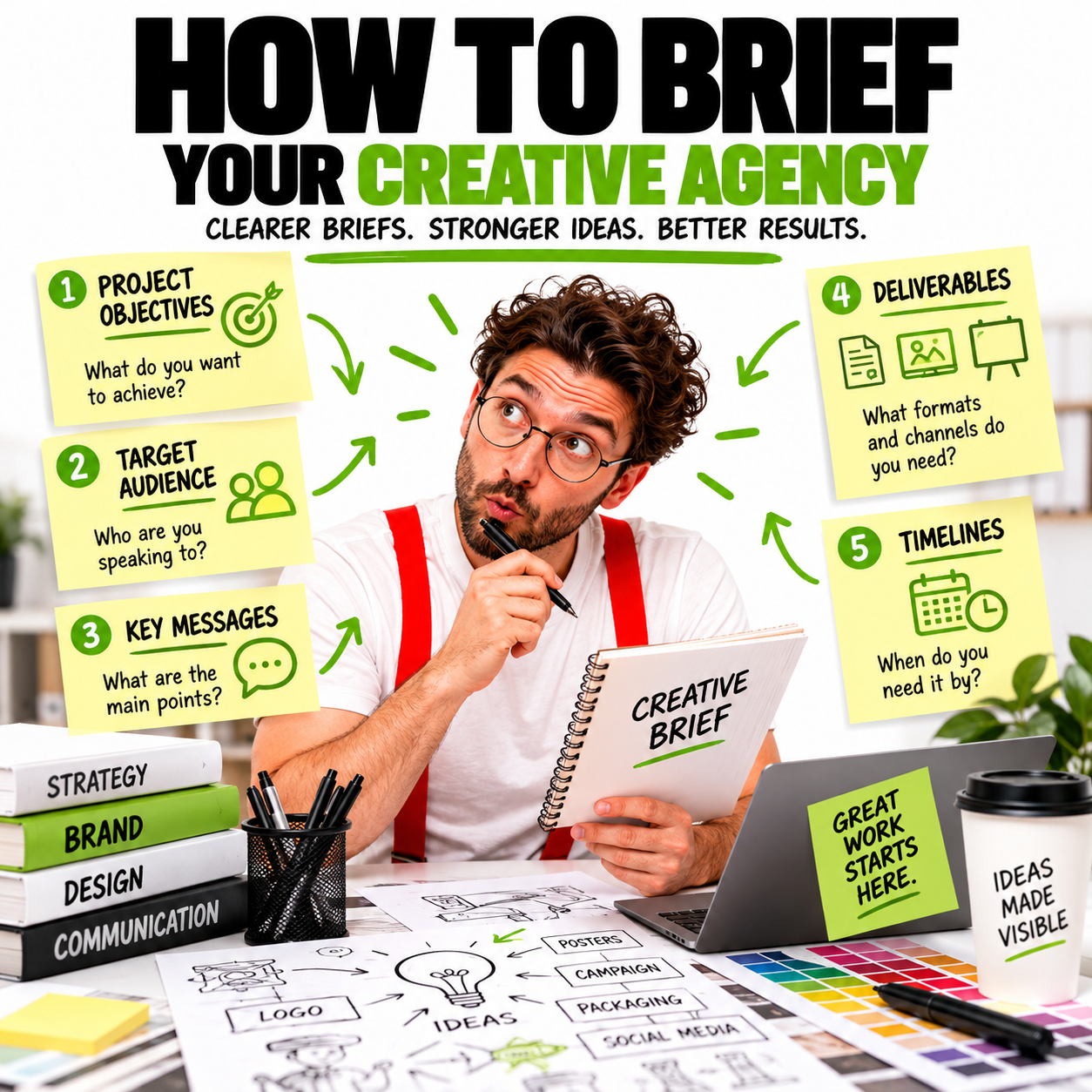
Great creative begins with clarity
A good creative brief gives us enough context to understand the challenge, focus the work, and make better creative decisions.
Start with what you know. We’ll help uncover what you don’t.
Whether you have a detailed brief or simply a business challenge you need help defining, that is enough to start a conversation. Tell us what you know, and we can help clarify what matters and shape the brief with you.
A good brief creates clarity before creative work begins. Music credit — Inspiration, EP Happy Whistling, Vernon, Pedosa Media Gp
Four key tips for preparing a good creative brief
1) Start with the business challenge
Every project exists for a reason. Before discussing execution, explain what is happening in the business.
- What has prompted the project?
- What needs to change?
- What challenge or opportunity are you addressing?
- What would you like the project to help achieve?
The clearer the challenge, the easier it is to develop work that supports the right outcome.
You do not need to diagnose the entire problem yourself. Share the context you have, and we can help sharpen the thinking.
Context helps us understand not simply what needs to be designed, but why the work needs to exist.
2) Explain what you want the work to achieve
Creative work should have a purpose beyond simply looking good.
Tell us what you want the audience to understand, feel, believe, or do after seeing the work.
If you already have customer insights, research, key messages, or other useful information, share them. If not, we can help explore these with you.
It is also useful to consider what success looks like — whether that means clearer communication, stronger awareness, better engagement, more enquiries, or another business outcome.
Clear objectives give creative thinking something meaningful to work towards.
3) Tell us who you need to reach
Tell us what you know about the people the work needs to connect with.
That may include customers, prospects, employees, partners, stakeholders, or the wider public.
You do not need a fully developed audience profile. Even basic knowledge about their needs, motivations, concerns, behaviours, or existing perceptions gives us a useful starting point.
Better audience understanding leads to more purposeful creative decisions.
4) Share the practical realities
Good creative work also needs to work in the real world.
Share relevant timelines, formats, channels, approval processes, existing brand guidelines, and anything that must — or must not — be included.
Budget is useful too.
Sharing a budget does not tell us what to charge. It helps us recommend a realistic scale of solution and focus the effort where it matters most.
If the budget is still being worked out, say so. A useful conversation can still begin.
Clear responsibilities and realistic timelines help keep a project moving and reduce avoidable rounds of revision.
A good brief is the beginning, not the finished strategy
Clients bring the business knowledge, objectives, constraints, and experience.
We bring questioning, diagnosis, strategic thinking, and creative direction.
A good briefing process brings the two together.
The aim is not to arrive with everything solved. It is to create enough clarity for the right thinking — and the right creative work — to begin.
Need a place to start?
JAB’s Creative Brief Template provides a simple one-page framework covering the business challenge, objective, audience, message, deliverables, timeline, budget, and decision-making.
The payoff from a good creative brief
A good creative brief helps everyone start from the same place.
It gives the project a shared point of reference, helps reduce misunderstandings, and makes it easier to assess whether proposed ideas actually address the business challenge and project objectives.
The key is clarity — enough useful information to focus the thinking without making the briefing process a hurdle.
Need help?
Tell us what you’re working on.
You do not need a finished brief to start the conversation.
Before we design, we define. Our process begins by clarifying the challenge, objectives, audience, and requirements so creative development stays focused on what the project needs to communicate and achieve.
Contact us or email us at info@jab.sg to start the conversation.
A strong brief doesn’t need to have every answer. It needs to give the right questions somewhere to begin.
Related Reading
- Design Project Onboarding Checklist
- Why Great Design Starts with Better Questions
- AI vs .AI Files: Why Your Printer Isn’t Asking for Artificial Intelligence
- RGB vs CMYK: Why Colours Look Different on Screen and in Print
- How to Create an Eye-Catching Infographic
Need help? Tell us about your project — email us or use our contact form.

