
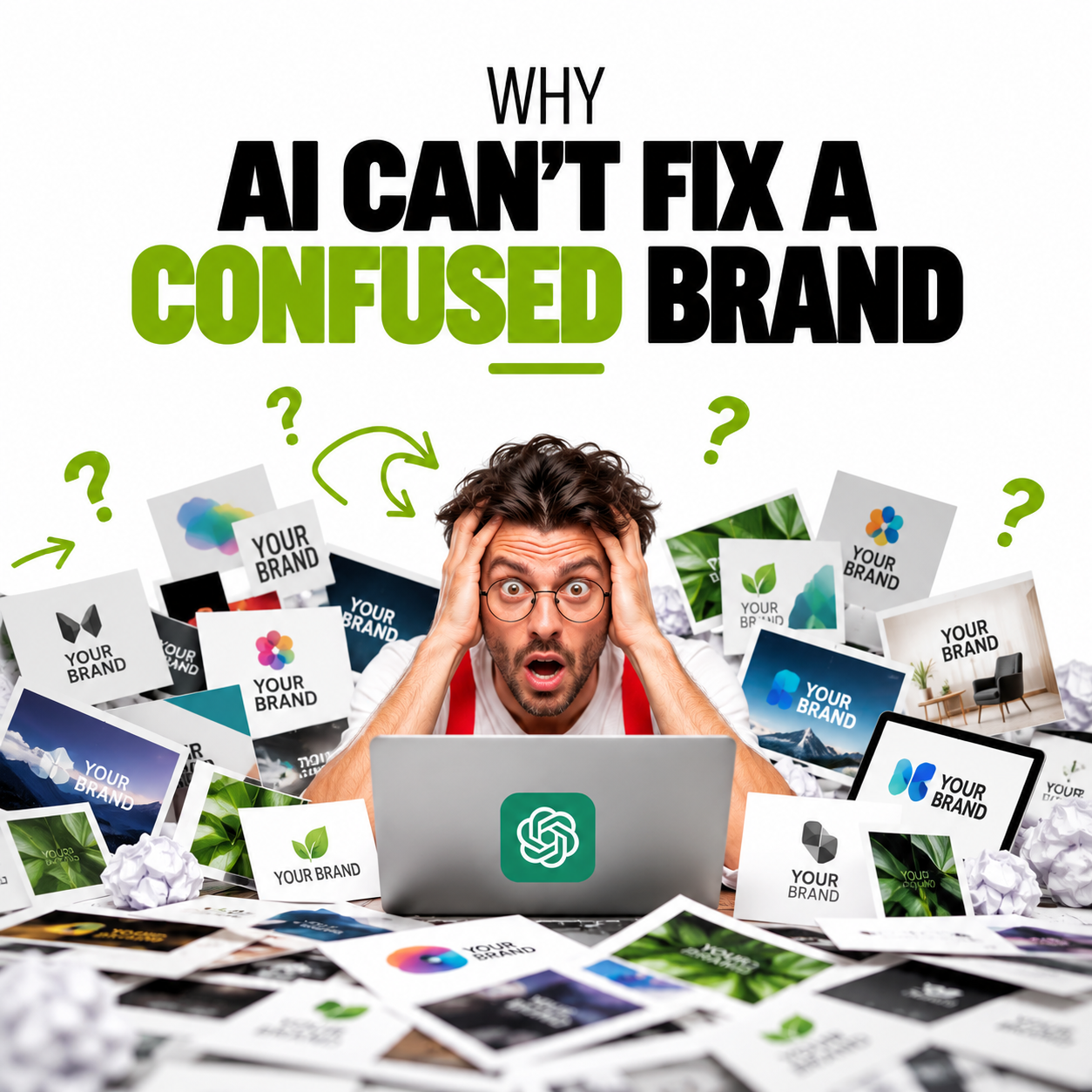
AI can write faster.
It can generate ideas faster.
It can produce more content in less time than ever before.
But speed does not create clarity.
If your business is clear about who it is, who it serves, and why it matters, AI can amplify that clarity.
If your business is confused, AI can amplify that too.
The difference isn’t AI.
It’s strategic clarity.
The strategy-to-content framework
This complements the JAB Framework. Before execution can be accelerated by AI, the business still needs clarity on strategy, positioning, and messaging.
The mistake isn’t using AI.
The mistake is asking AI to solve a problem that leadership hasn’t yet defined.
Strategy defines.
AI accelerates.
The problem usually starts before the prompt
Many organisations begin with questions such as:
- Can AI write our website?
- Can AI create our social media content?
- Can AI draft our company profile?
- Can AI generate campaign ideas?
- Can AI help us market faster?
Those are useful questions. But they are execution questions.
Before any of them, there is a more important one:
What business problem are we trying to solve?
That question changes the conversation.
The real issue may not be a lack of content.
It may be unclear positioning.
It may be an undifferentiated value proposition.
It may be inconsistent messaging.
It may be that different stakeholders describe the business in completely different ways.
AI can help explore these issues.
It cannot take responsibility for the judgement required to resolve them.
AI can support the thinking. It cannot own the decision.
Good strategy involves choices.
Who should we serve?
What should we become known for?
What should we stop saying?
Which opportunities should we pursue?
Which ones should we deliberately walk away from?
These decisions require context, experience, evidence, trade-offs, and stakeholder alignment.
AI can assist. It can research, compare, organise, challenge assumptions, and generate possibilities.
But the final judgement still belongs to the business.
AI can support the thinking. It cannot own the decision.
Strategy comes before content
It is tempting to use AI to solve a communication problem immediately.
Write more.
Post more.
Publish more.
But more output does not automatically create a stronger brand.
If the positioning is weak, more content simply repeats weak positioning.
If the message is unclear, more content distributes that lack of clarity more efficiently.
If the organisation does not know what makes it different, AI is forced to fill the gaps with assumptions.
Those assumptions may sound polished.
That does not make them strategically correct.
The AI amplifier effect
A useful way to think about AI is as an amplifier.
| What Goes In | What AI Helps Produce |
|---|---|
| Clear positioning | More consistent communication |
| Strong value proposition | More focused messaging |
| Clear audience understanding | More relevant content |
| Weak differentiation | More generic marketing |
| Confused brand direction | More confusion, faster |
The tool is not the differentiator.
The clarity behind the tool is.
When everyone has AI, what becomes the advantage?
As AI tools become easier to access, they become less of a competitive advantage on their own.
Your competitors can use the same tools.
They can generate the same types of headlines.
They can produce the same kinds of social posts.
They can create the same volume of content.
So the advantage shifts upstream.
It shifts towards:
- better diagnosis
- clearer positioning
- stronger customer understanding
- more disciplined choices
- better business judgement
- more distinctive ideas
That is where strategy matters.
AI does not create competitive advantage by itself.
It amplifies the clarity, capability, and differentiation that already exist.
Five questions to answer before asking AI to market your business
Before generating another batch of content, ask:
- What business problem are we actually trying to solve?
- Who are we trying to influence?
- Why should they choose us instead of an alternative?
- What do we want to become known for?
- What evidence gives people a reason to believe us?
If these answers are unclear, the next prompt is not the priority.
The thinking is.
A confused brand can still produce excellent-looking content
This is one of the more dangerous effects of AI.
Weak thinking can now look surprisingly polished.
A business can produce elegant copy, attractive images, professional presentations, and constant social media content without ever resolving its underlying strategic issues.
Activity can create the appearance of progress.
But activity and progress are not the same thing.
A brand becomes stronger when the organisation becomes clearer about what it stands for, who it serves, and why its proposition matters.
AI can help express that.
It cannot substitute for it.
Diagnosis before execution
At JAB Design, we prefer to begin before the execution stage.
Before asking what a brochure should look like, we ask what it needs to achieve.
Before discussing a campaign, we ask what behaviour or perception needs to change.
Before refreshing a brand, we ask what business pressure is driving the change.
And before asking AI what to produce, we ask what problem it is supposed to help solve.
This is why our approach remains:
Before We Design, We Define.
Technology may change the way work is produced.
It does not remove the need for diagnosis, judgement, and strategic clarity.
AI has a valuable role
This is not an argument against AI.
Quite the opposite.
Used well, AI can be extremely useful for:
- research and synthesis
- exploring different perspectives
- testing messaging directions
- developing content frameworks
- accelerating first drafts
- organising information
- supporting creative exploration
- improving efficiency during execution
But these benefits become more valuable when the strategic foundation is already sound.
The better the input, the more useful the output.
What matters more?
AI will continue to improve.
It will become faster, more capable, and more embedded in everyday business.
That makes strategic clarity more important, not less.
When everyone can generate, the quality of judgement matters more.
When everyone can produce, differentiation matters more.
When everyone can speak, knowing what is worth saying matters more.
Before you ask AI what to say, decide what your business needs to say.
Related Reading
- The JAB Framework
- Identity & Branding
- How to Brief Your Creative Agency
- The Jab That Lands
- Powerful Key Differentiators
More About What We Do
Our creative expertise spans four core disciplines:
Need help? Tell us about your project — email us or use our contact form.

