
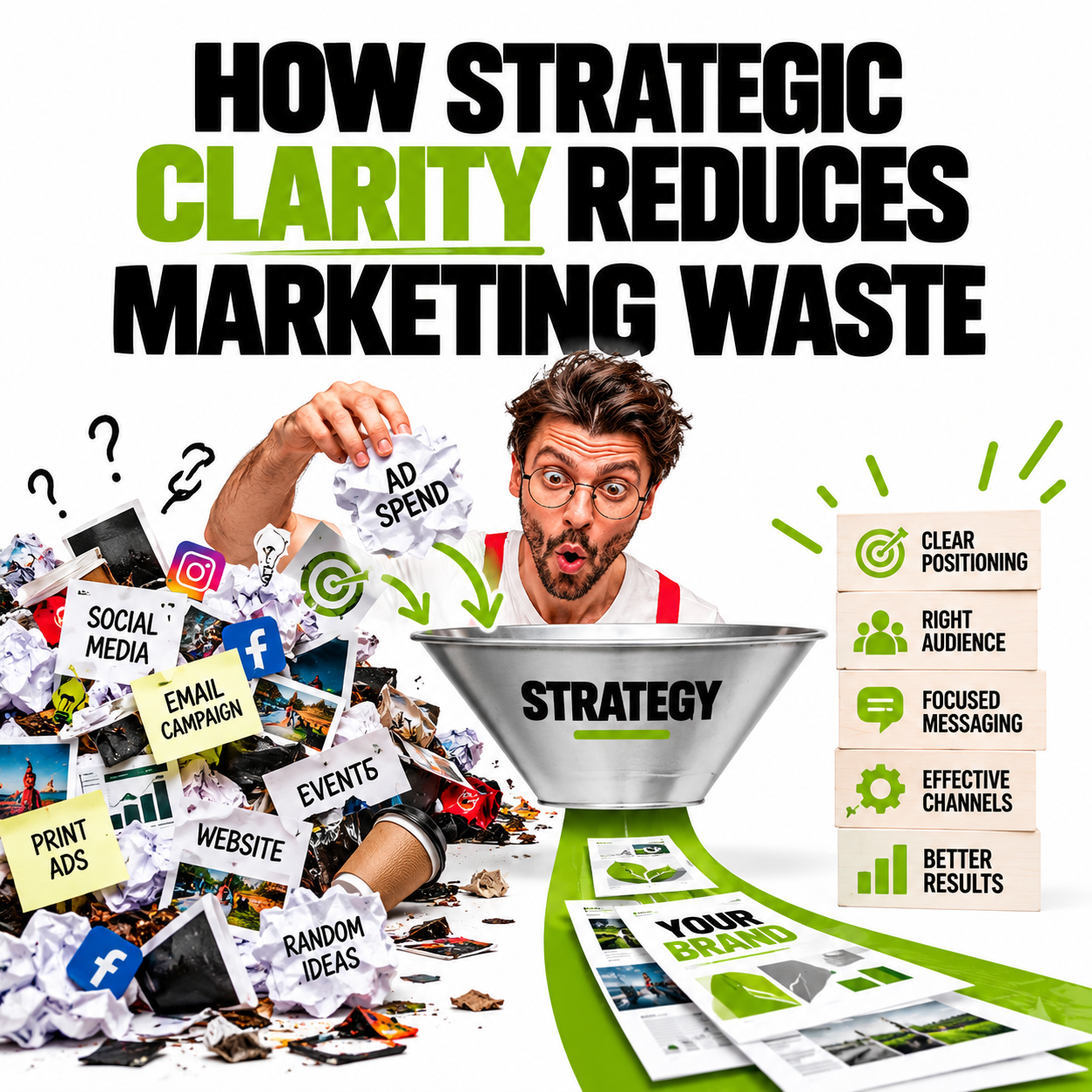
Cause and effect
Many organisations turn to branding and marketing when business performance starts to weaken. Sales may be slowing, enquiries declining, market share eroding, or growth stalling.
These symptoms often appear to be marketing problems — but they are not always caused by marketing.
Sometimes, branding and marketing initiatives help.
Often, they simply make an organisation spend more money solving the wrong problem.
Effective marketing cannot compensate for an unclear strategy.
Before investing in branding or marketing, organisations should first ask: Are we solving the right business problem?
Activity is not strategy
A company can be extremely busy without making meaningful progress.
- Redesigning brochures
- Launching new campaigns
- Attending exhibitions
- Boosting social media posts
- Producing more videos
- Running Google Ads
Yet six months later, very little may have changed.
The reason is surprisingly simple: marketing can only amplify what already exists.
When an organisation lacks strategic clarity, marketing simply amplifies confusion. Marketing accelerates direction. It cannot create direction.
Where marketing waste usually begins
Marketing waste rarely begins with a poor designer or an ineffective advertising campaign. It usually begins much earlier.
Common signs include:
- An unclear value proposition
- Inconsistent messaging
- An undefined target audience
- Competing internal priorities
- Products or services that are difficult to differentiate
- Multiple decision-makers with different expectations
Creative agencies are then asked to produce materials based on assumptions rather than evidence. The result may be beautiful work that struggles to deliver meaningful business outcomes.
Strategic diagnosis before creative execution
This is where management consulting plays a different role from creative execution.
Before recommending solutions, a Practising Management Consultant (PMC) asks questions such as:
- What business problem are we actually trying to solve?
- Is this really a branding issue?
- Has customer behaviour changed?
- Are internal processes affecting the customer experience?
- What evidence supports the proposed solution?
- Are we measuring the right outcomes?
Only after understanding these factors does branding become meaningful.
The objective is not to create more marketing. It is to ensure every marketing dollar works harder.
When two companies face the same challenge
Imagine two companies experiencing declining enquiries.
Company A: Execution first
Company A assumes its logo looks dated. It commissions a complete rebrand.
Six months later, enquiries remain flat.
Company B: Diagnosis first
Company B begins with strategic diagnosis.
The investigation reveals that:
- Prospects do not understand the company’s specialist expertise
- Sales messaging varies between departments
- The website answers internal questions instead of customer questions
- Existing clients generate most referrals, yet referral opportunities are underdeveloped
The logo remains unchanged.
Instead, the company improves its positioning, messaging, and customer journey. Marketing expenditure remains broadly similar, but its activities become more focused.
The difference was not creativity. It was diagnosis.
The hidden cost of skipping strategy
When organisations bypass diagnosis, they often pay repeatedly for the same unresolved problem:
- A website redesign
- Another agency
- Another campaign
- Another social media initiative
- Another brochure
- Another slogan
Each project may be professionally executed. Yet none addresses the real issue.
The cumulative cost can be significant — not only in money, but also in management time, employee confidence, and lost business opportunities.
When the underlying problem remains unresolved, every new marketing activity risks becoming another layer of expenditure rather than a source of progress.
Strategic clarity creates better decisions
Strategic clarity provides a framework for decision-making.
Instead of asking: “What should we design?” Organisations begin asking: “What outcome are we trying to achieve?”
That subtle shift changes everything.
- Creative decisions become easier
- Marketing budgets become more focused
- Internal teams become better aligned
- Suppliers receive clearer briefs
- Customers experience greater consistency
From business challenge to business outcome
A strategy-led branding process begins with understanding and defining the business challenge (Steps 1–3), before moving into strategy development, creative execution, marketing activities and measurable business outcomes (Steps 4–7).
Design does not disappear from the process. It enters at the right time, with a clearer purpose.
Branding connects strategy with expression
Branding is often misunderstood.
A brand is not simply a logo, colour palette, or website. Those are visible expressions of a wider strategy. Without strategic clarity, visual identity can become decoration.
With strategic clarity, branding becomes a business asset — helping an organisation communicate consistently, differentiate meaningfully, and build confidence among the people it needs to reach.
Branding translates business strategy into a meaningful identity and experience — it does not replace the need for clear business direction.
A PMC perspective
One of the core responsibilities of a Practising Management Consultant (PMC) is resisting the temptation to prescribe solutions too early.
Diagnosis comes before recommendation. Evidence comes before execution.
The same discipline should apply to branding.
Sometimes the correct recommendation is a new visual identity.
Sometimes it is clearer positioning, stronger messaging, better stakeholder alignment, or an improved customer experience.
Sometimes the underlying issue has little to do with marketing at all.
The discipline lies in identifying the real problem before investing in the solution.
Good branding makes organisations look better. Strategic branding helps organisations perform better.
Questions worth asking before the next marketing investment
Before approving another campaign, redesign, or marketing initiative, decision-makers should ask:
- What business problem are we trying to solve?
- What evidence shows that this is the real problem?
- Are we addressing a root cause or merely a visible symptom?
- Who must understand, believe, or act differently?
- What should success look like?
- Are internal stakeholders aligned?
- Is branding the appropriate solution?
Only after these questions are answered should creative execution begin.
Strategic clarity reduces waste before it begins
Marketing budgets are finite. Every unnecessary campaign, redesign, or promotional initiative carries an opportunity cost.
Strategic clarity helps organisations reduce expenditure on activities that create little value while investing more confidently in initiatives that support meaningful business outcomes.
Before asking, “How should we market this?”, organisations should first ask: “Are we solving the right problem?”
The answer may save far more than the next marketing budget.
JAB principle
At JAB Design, we believe effective branding begins with understanding the business challenge — not prescribing a creative solution before defining the problem.
As a strategy-led branding and creative agency, JAB Design brings an SBACC-certified Practising Management Consultant (PMC) perspective to understanding business challenges before recommending strategic and creative solutions.
Strategic clarity is not an optional first step. It is what makes every subsequent marketing investment more effective.
Related Reading
- Branding vs Marketing: Which Comes First?
- The JAB Framework
- How to Brief Your Creative Agency
- EDGE Grant and BizSG
- Identity & Branding Services
More About What We Do
Our creative expertise spans four core disciplines:
Need help? Tell us about your project — email us or use our contact form.

