
A brand is more than a logo, colour palette, or tagline.
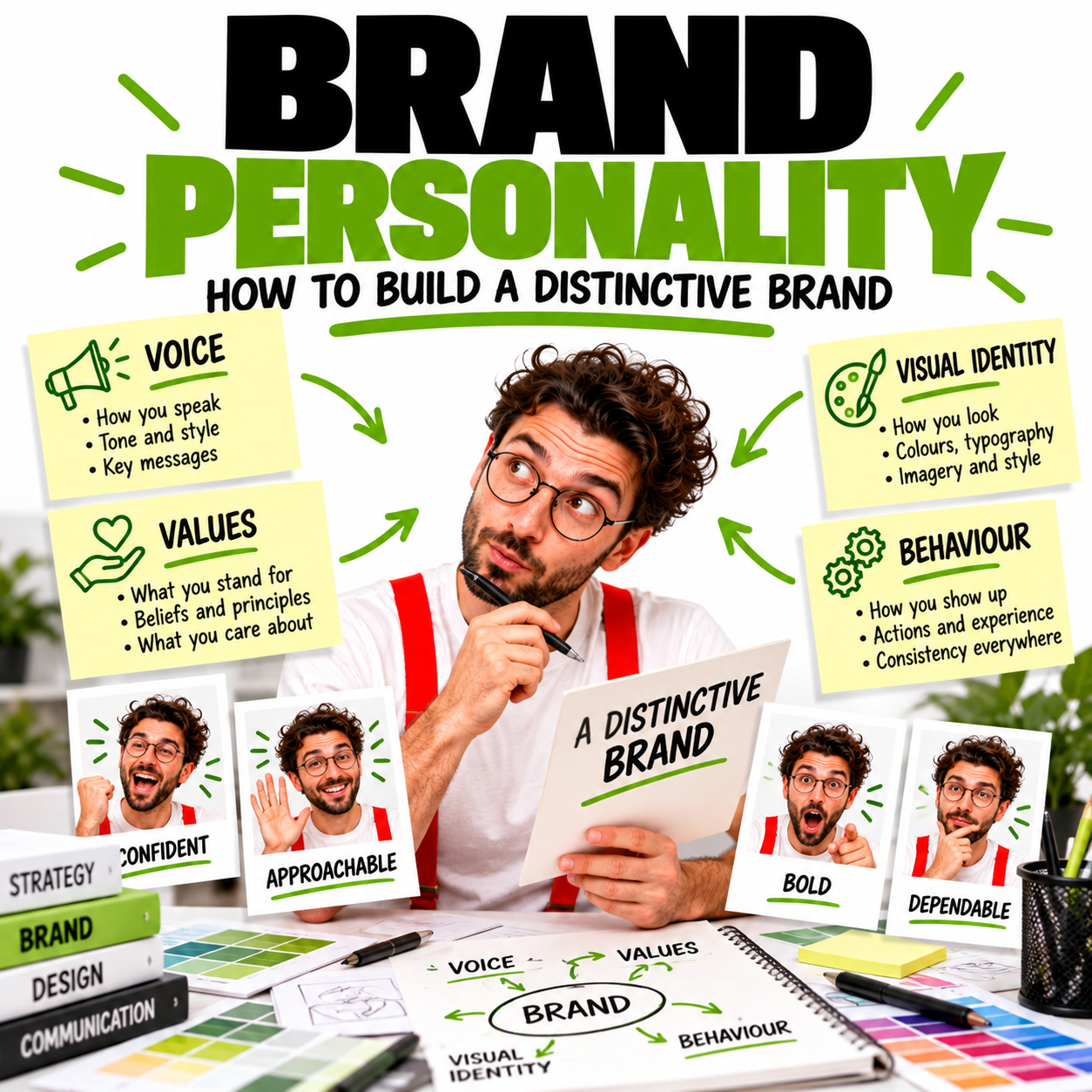
The strongest brands have a recognisable personality — a consistent way of thinking, speaking, looking, and behaving that helps people understand who they are.
Think about brands you know well. Some feel confident and authoritative. Others are warm and approachable. Some are energetic and irreverent; others are quiet, precise, and dependable.
That impression does not come from a logo alone.
It comes from the accumulated experience of the brand: its language, visual identity, communications, customer interactions, and the choices it makes.
A logo identifies a brand. A personality makes the brand identifiable.
What is brand personality?
Brand personality is the recognisable human character of a brand — how it tends to think, speak, look, and behave.
If your organisation were a person entering a room, how would that person come across?
Confident? Warm? Serious? Curious? Progressive? Reassuring? Bold? Meticulous?
More importantly: would customers, employees, and stakeholders describe that person in roughly the same way?
Brand personality gives an organisation a recognisable character. It helps determine how the brand communicates, how it presents itself visually, and how it behaves across different situations.
Without that definition, communications can easily become inconsistent — formal in one place, playful somewhere else, highly technical on the website, and generic on social media.
The individual pieces may all look competent, but together they may not feel like one brand.
Brand personality is not the same as brand identity
The terms brand personality, brand identity, brand voice, and brand positioning are related, but they are not interchangeable.
- Brand positioning defines the place you want the brand to occupy in the market and in the audience’s mind.
- Brand personality defines the human characteristics and behaviour associated with the brand.
- Brand voice translates that personality into language and communication.
- Brand identity expresses the brand visually through elements such as logo, typography, colour, imagery, and graphic systems.
They should reinforce one another.
A brand positioned as an accessible, progressive challenger, for example, may struggle if its language is bureaucratic and its visual identity feels conservative and institutional.
That is why defining the brand should come before designing its expression.
Before We Design, We Define.
Why brand personality matters
Products, features, prices, and capabilities can often be matched. What is much harder to replicate is the reputation, character, behaviour, and experience people associate with a particular brand.
A clearly defined personality can help a brand:
- Create a more distinctive market presence
- Communicate more consistently
- Guide creative and content decisions
- Build familiarity and recognition
- Create stronger emotional associations
- Give internal teams and external partners clearer direction
It is therefore not simply a creative exercise. Brand personality can function as a practical decision-making framework.
Six questions to define your brand personality
1. What does your brand really stand for?
Start beneath the visuals.
Many organisations describe themselves using words such as quality, innovation, integrity, excellence, and customer-focused. There is nothing inherently wrong with these values, but they are so widely used that they rarely distinguish one organisation from another.
Ask instead:
- What principles genuinely influence our decisions?
- What do we care about enough to defend?
- What do we consistently do differently?
- What would we refuse to compromise?
Personality becomes credible when it grows from actual organisational behaviour rather than adjectives selected in a workshop.
2. How should people describe you?
Imagine asking a customer to describe your organisation after working with you.
What three or four characteristics would you want to hear?
For example:
Confident. Thoughtful. Precise. Approachable.
Or:
Energetic. Bold. Optimistic. Unconventional.
Neither is inherently better. What matters is whether the characteristics are appropriate to the organisation, audience, and positioning.
It is equally useful to define what the brand should never become.
A brand might want to be authoritative, but never arrogant. Friendly, but never frivolous. Premium, but never intimidating. Innovative, but never confusing.
These boundaries make personality considerably more useful when real decisions have to be made.
3. How should your brand sound?
Brand personality should influence language.
Should communication be formal or conversational? Technical or accessible? Reserved or expressive? Direct or diplomatic?
A defined brand voice helps answer everyday questions such as:
- How should website copy sound?
- How should proposals be written?
- How should social content communicate?
- How should the organisation explain complex information?
- How should it respond when something goes wrong?
The goal is not to make every sentence identical. Context still matters. A legal notice and an Instagram caption naturally serve different purposes.
But they should still feel as though they come from the same organisation.
4. Does your visual identity match the personality?
Visual identity is one of the most immediate expressions of personality.
Typography can feel authoritative, friendly, technical, or editorial. Colour can signal energy, restraint, warmth, or confidence. Photography can feel polished, human, documentary, or aspirational. Layout and graphic systems can feel disciplined or expressive.
Problems arise when the intended personality and visual expression contradict one another.
An organisation may say it wants to be warm and accessible while presenting itself through cold imagery and highly institutional design. Another may claim to be progressive while looking almost indistinguishable from competitors.
The question is therefore not simply: “Does this look good?” A more useful question is: “Does this look and feel like us?”
5. How should the brand behave?
Personality should not disappear when the marketing ends.
If a brand claims to be helpful but its customer experience is difficult, the personality is not credible. If it claims to be responsive but routinely leaves enquiries unanswered, no amount of friendly copy will compensate.
Consider how the intended personality appears across:
- Sales and business development
- Customer service
- Proposals and presentations
- Onboarding
- Digital interactions
- Physical environments
- Social media
- Complaint handling
The strongest brands do not merely describe their personality. They demonstrate it.
6. Would people recognise you without seeing the logo?
This is a useful test of brand distinctiveness.
If the logo were removed from an advertisement, presentation, social post, or campaign, would the audience still have a reasonable chance of recognising the organisation behind it?
Recognition can come from a combination of:
- Language
- Tone
- Typography
- Colour
- Photographic style
- Graphic elements
- Ideas
- Behaviour
- Consistent points of view
A distinctive brand becomes recognisable through the whole system, rather than depending entirely on its logo.
Consistency makes a brand familiar. Distinctiveness makes it memorable.
Brand personality in the age of AI
Generative AI has made competent content increasingly easy to produce.
Almost any organisation can now ask an AI tool to write something that sounds “professional, friendly, and engaging”. It can produce social posts, headlines, emails, articles, presentations, and visual concepts within seconds.
But if every organisation gives AI essentially the same instructions, the results can quickly converge towards the same generic middle ground.
That makes clearly defined brand personality more important, not less.
The useful question is no longer simply: “Can AI create this?” It is: “What makes the result unmistakably ours?”
AI can help express a brand personality. It should not be expected to invent one from nothing.
Before using AI extensively for brand communications, organisations should therefore define the strategic foundations that guide it: audience, positioning, personality, voice, messaging principles, and visual direction.
Otherwise, AI may simply help the organisation produce inconsistent or generic communication faster.
A simple brand personality test
Try completing these statements without referring to your existing website or brand guidelines:
- Our brand believes…
- Our brand is…
- Our brand is not…
- Our brand speaks like…
- Our brand never sounds…
- People should feel… after interacting with us.
- Our visual identity should feel…
- If our logo disappeared, people would still recognise us because…
If the answers come easily and stakeholders broadly agree, your brand probably has a reasonably clear personality.
If everyone produces different answers, the problem may not be creative execution. The brand itself may need greater strategic clarity.
Define before you design
Brand personality should not be an arbitrary collection of adjectives added after the logo has been designed.
At JAB Design, we believe brand personality should emerge from the organisation’s purpose, audience, positioning, values, and ambitions — and then guide how the brand speaks, looks, and behaves.
That clarity gives designers, writers, marketers, internal teams, and increasingly AI systems a common point of reference.
The result is not merely greater consistency.
It is a brand that is easier to recognise, understand, and remember.
Before We Design, We Define. Clear thinking creates stronger brands.
Related Reading
- Why Great Design Starts with Better Questions
- Why AI Can’t Fix a Confused Brand
- When Everything Looks Alike, How Do You Stand Out?
- Branding vs Marketing: Which Comes First?
- How Strategic Clarity Reduces Marketing Waste
- Brand Identity: When Similar Company Names Aren’t the Real Problem
More About What We Do
Our creative expertise spans four core disciplines:
Need help? Tell us about your project — email us or use our contact form.

