
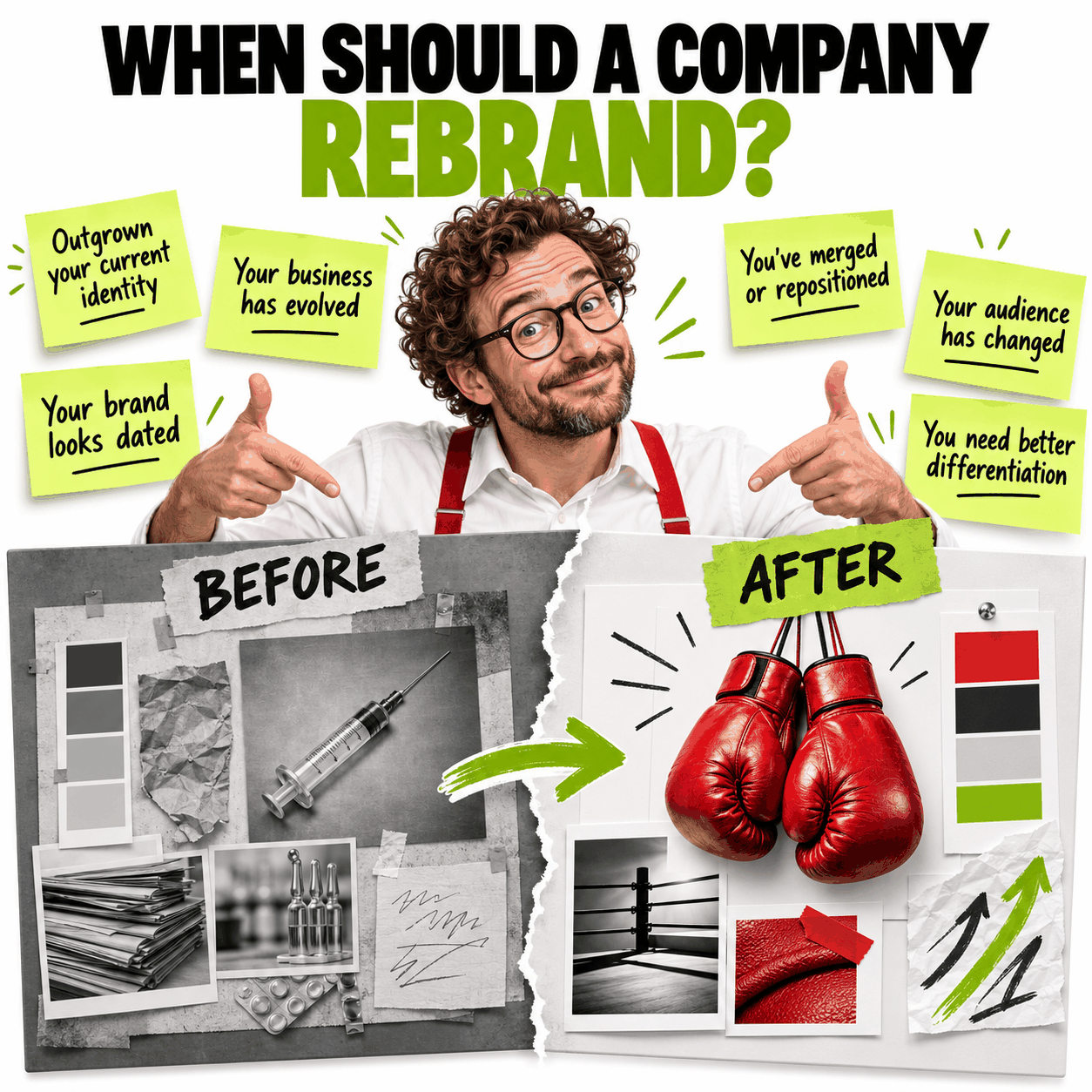
Rebranding is a significant business decision.
Yet the conversation often begins with something surprisingly small:
“Our logo looks dated.”
That may be true. But an ageing logo does not automatically mean the business needs a rebrand.
A brand can look tired while its positioning remains sound. Conversely, a company can have a perfectly respectable identity while the business behind it has changed so substantially that the brand no longer tells the right story.
The more useful question, therefore, is not:
“Is it time for a new logo?”
It is:
“Does our brand still accurately represent the business we are today — and the business we intend to become?”
That distinction matters.
Rebranding should follow business change
Companies evolve.
A business that started by serving small local customers may now be pitching to multinational corporations. A specialist company may have expanded into several service areas. A family business may have professionalised its management and ambitions. Two organisations may have merged. A company may be entering new markets or trying to move from being seen as a supplier to being valued as a strategic partner.
In each case, the business has moved.
The brand may not have moved with it.
This is where rebranding becomes a strategic consideration rather than a cosmetic exercise.
A rebrand should therefore begin with understanding what has changed in the business, rather than deciding what should change visually.
When the brand tells an outdated story
One of the clearest reasons to consider rebranding is a growing gap between what the company has become and what people think it is.
Perhaps your visual identity still suggests a small operation when the organisation has grown considerably.
Perhaps your messaging continues to emphasise a product that is no longer central to the business.
Or perhaps the company has developed capabilities, expertise, and credibility that are barely visible in the way it presents itself.
This creates more than an aesthetic problem.
Customers form expectations from what they see and hear. If the brand communicates yesterday’s company, the business may constantly have to explain today’s company.
At that point, the brand is no longer helping the organisation move forward. It may actually be creating friction.
In practice: Plus! becomes Link Rewards
A useful Singapore example is the transformation of Plus! Rewards Programme into Link Rewards Programme in 2022.
The programme had grown beyond its historical association with grocery shopping. Its proposition and partner ecosystem were expanding, and the new Link Rewards identity was introduced as part of that broader direction.
The important point is not simply that the name changed.
The proposition had become broader than what the existing brand was commonly associated with. The brand needed to better represent what the programme had become and where it was going.
What this illustrates: When the proposition grows beyond existing market perception, the brand may need to catch up.
Source: FairPrice Group — Plus! rebrands to Link Rewards Programme
When your market or audience has changed
Businesses do not always serve the same customers forever.
A company may move from consumer to corporate markets, from SMEs to larger enterprises, from Singapore to regional markets, or from transactional work to higher-value engagements.
The existing brand may still be recognised and trusted, but recognition alone is not enough.
Ask whether it remains relevant to the people the business now needs to reach.
A brand created for one audience may communicate the wrong signals to another. Tone of voice, positioning, visual language, and even the company name may need to be reconsidered when the intended audience changes significantly.
This does not automatically require abandoning everything that came before.
It does mean the existing brand deserves examination.
When growth has made the brand fragmented
Growth creates another problem: accumulation.
A company launches new products. Departments create their own materials. New services receive new names. Different teams commission different designers. Presentations evolve independently from websites, brochures, social media, and sales materials.
Eventually, there may be many pieces of communication but very little sense of one brand.
This is sometimes mistaken for a simple consistency problem.
It may be.
But when the fragmentation reflects deeper confusion about what the company stands for, how its offerings relate to one another, or which messages should take priority, applying a new graphic template will not solve it.
The organisation may need to revisit the structure beneath the design.
In practice: FairPrice Group
The establishment of FairPrice Group provides a different type of example.
FairPrice Group brought businesses including FairPrice, Kopitiam, Foodfare, and Link together under a broader group structure.
The answer was not simply to eliminate the established individual brands and replace them with one name. A group identity instead provided a way of connecting different businesses and propositions within a larger organisational story.
This is fundamentally a brand architecture question.
As companies grow, the challenge may not be whether individual logos look consistent. The more important question can become how multiple businesses, products, or services relate to one another — and whether customers and stakeholders can understand that relationship.
What this illustrates: Sometimes the answer is not to replace established brands, but to clarify how they fit together.
Source: FairPrice Group — Our Group
When perception is holding the business back
Sometimes the business has already changed, but market perception has not.
This can happen when a company is trying to move up the value chain.
It may have invested in people, capabilities, technology, and expertise, yet customers continue to associate it with its earlier, narrower offering.
A rebrand cannot manufacture credibility that does not exist.
But where the substance is already there, clearer positioning and a more appropriate identity can help the market recognise what has changed.
In other words, rebranding should not be used to pretend the company has evolved.
It should help communicate an evolution that has genuinely taken place.
When there has been a merger, acquisition or major restructuring
Some business changes naturally force a brand question.
Mergers and acquisitions are obvious examples.
Should one brand absorb the other? Should both remain? Should a completely new identity be created? What happens to existing brand equity? How should different products, divisions, or subsidiaries relate to the parent organisation?
Major changes in corporate structure can create similar questions.
These are not primarily logo decisions. They involve brand architecture, positioning, stakeholder expectations, and business strategy.
Design comes later, once those decisions are clearer.
In practice: NTUC Income Becomes Income Insurance
In 2022, NTUC Income completed its corporatisation, moving from a co-operative structure to Income Insurance Limited, a public non-listed company.
Income explained that corporatisation would provide greater flexibility and access to strategic growth options while allowing it to continue pursuing its social purpose.
Seen in that context, the change in corporate identity was not simply about giving an established insurance brand a new appearance.
The organisation itself had changed.
Its brand therefore needed to represent the corporate entity it had become while retaining valuable recognition and trust built over many years.
What this illustrates: When the organisation fundamentally changes, its brand may need to change with it.
When the identity no longer works
There are also occasions when the problem genuinely is visual.
An identity developed many years ago may not function well across today’s applications. It may become illegible at small sizes, perform poorly on digital platforms, lack a coherent visual system, or be difficult to apply consistently.
Even then, a full rebrand may not be necessary.
A well-established brand with strong recognition and relevant positioning may benefit from an identity refresh rather than wholesale replacement.
Preserving useful brand equity can be just as important as creating something new.
The objective should not be to make a brand different simply for the sake of difference.
When not to rebrand
There is a temptation to treat rebranding as a reset button.
- Sales are slowing.
- A new competitor has appeared.
- A new management team wants to signal change.
- The organisation is tired of looking at the same identity.
- Someone simply thinks the logo needs to look “more modern”.
None of these, by themselves, establishes a case for rebranding.
A new identity cannot fix a weak product, poor customer experience, unclear business strategy, or lack of market demand. Nor should companies discard years of recognition simply because their logo no longer feels exciting internally.
Familiarity has value.
Before replacing it, understand what is actually wrong.
Refresh, reposition or rebrand?
Not every brand problem requires the same response.
A brand refresh may be appropriate when the underlying positioning remains relevant but the visual identity or communications need refinement.
A repositioning may be needed when the business needs to change how it is understood or differentiated, even if much of the existing identity can remain.
A rebrand becomes more appropriate when substantial changes in the business, audience, market position, or organisational direction require the brand itself to be reconsidered.
And sometimes none of the three is necessary.
The problem may lie elsewhere entirely.
The boundaries are not always neat. That is precisely why defining the problem should come before prescribing the solution.
Before you call it a rebrand
Before commissioning a new identity, start with a few harder questions:
- What has changed in the business?
- What do customers currently believe about us?
- What do we need them to understand differently?
- Who are we trying to reach today — and tomorrow?
- Which parts of the existing brand still have value?
- What problem would a rebrand actually solve?
And perhaps most importantly:
If we changed nothing visually, would the underlying business problem still exist?
If the answer is yes, start there.
A successful rebrand should not merely make an organisation look different. It should make the organisation clearer, more relevant, and more accurately understood.
At JAB Design, this is why we believe in defining before designing.
Because sometimes a company needs a new identity.
Sometimes it needs to rethink its positioning.
Sometimes it needs only to refresh what it already has.
And sometimes, after asking the right questions, it discovers that it does not need to rebrand at all.
Related Reading
- Do I Need Branding or Just Design?
- Brand Audit: Essential Questions
- Building Stronger Brands
- Brand & Growth Diagnostic
- What Is Brand Strategy vs Logo Design?
More About What We Do
Our creative expertise spans four core disciplines:
Need help? Tell us about your project — email us or use our contact form.

