
Your name introduces you. Your positioning defines you. Strong brands are remembered not because their names are unique, but because their purpose is clear.
Before We Design, We Define.
Can two companies have remarkably similar names and still build distinctive brands?
The answer is yes.
In fact, there are examples right here in Singapore.
This isn’t simply a story about naming. It is a lesson in positioning, perception, and strategic clarity. Two organisations operating within the same industry demonstrate that a brand is defined less by its name than by the position it occupies in people’s minds.
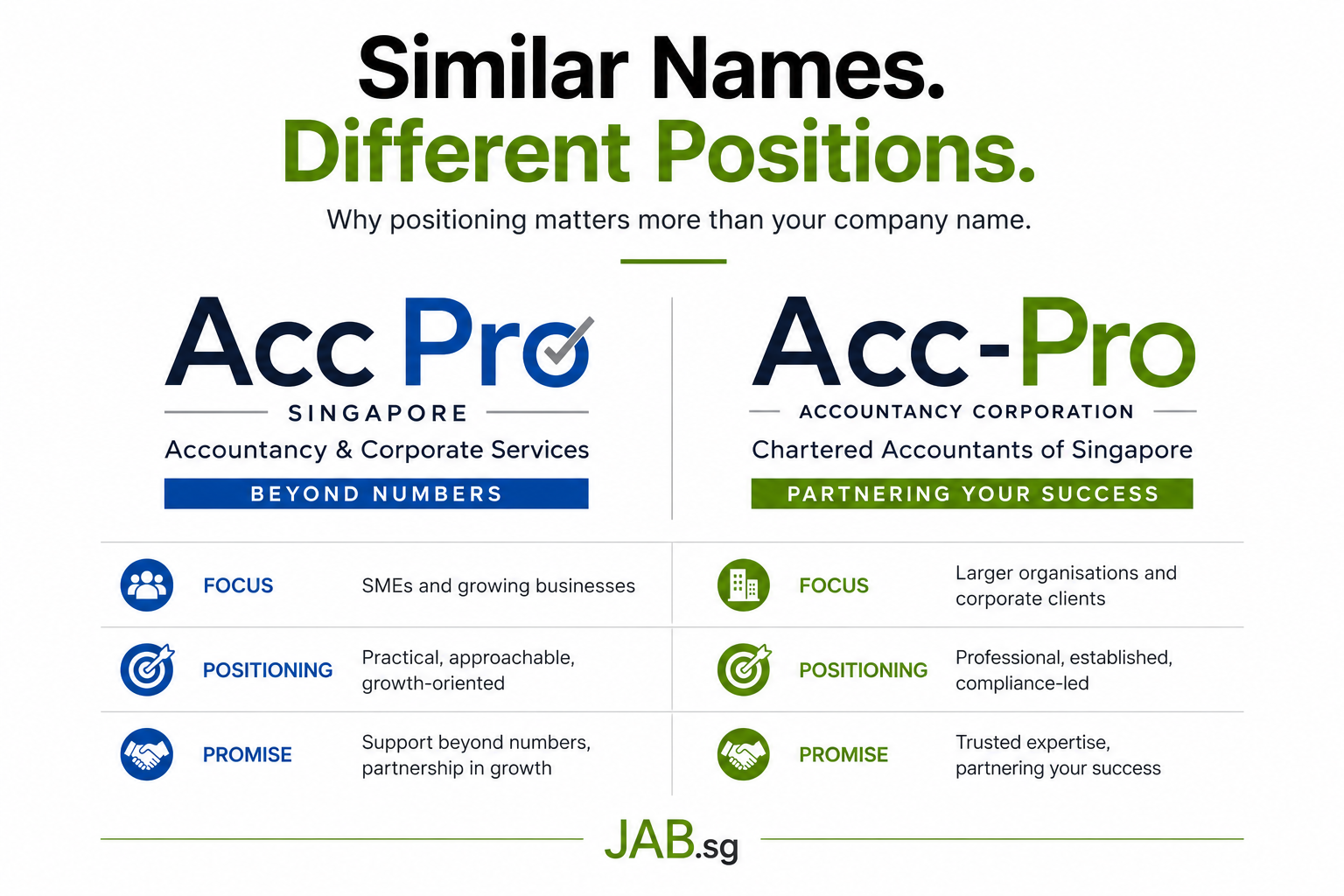
Similar names. Different positions.
Same industry. Similar names. Different strengths.
Acc Pro (Singapore) and Acc-Pro Business Group are two established accounting and corporate services firms in Singapore. Their names are strikingly similar, yet each has developed its own distinctive identity.
Acc Pro (Singapore) positions itself around digital accounting, cloud technologies, and business transformation.
Acc-Pro Business Group has built its reputation on dependable accounting, taxation, payroll, and corporate secretarial services backed by years of experience. Its longstanding experience in serving Singapore’s SME community reinforces its emphasis on dependable accounting and corporate support.
Neither approach is inherently better. Each presents a different set of strengths that may appeal to different client needs.
Together, these organisations demonstrate that companies with similar names can build distinctive market identities through clear positioning, consistent messaging, and a genuine understanding of their customers.
Acc Pro (Singapore)
Digital accounting and business transformation
Cloud accounting, automation, and business advisory
Modern, technology-driven, and forward-looking
Acc-Pro Business Group
Accounting, taxation, and corporate compliance
Payroll, bookkeeping, taxation, and corporate secretarial services
Experienced, dependable, and compliance-focused
The observations above are based on publicly available information and are intended solely to illustrate how organisations can develop distinctive market identities despite operating within the same industry.
Your name introduces you. Your positioning defines you.
Many business owners believe branding begins with choosing a memorable company name or designing a distinctive logo.
Those elements certainly matter.
But they are only the introduction.
Customers ultimately remember companies for something much more meaningful:
- What do you specialise in?
- What problems do you solve?
- What strengths are you known for?
- When should customers think of you?
Those answers help define your position in the market — and give your brand identity something meaningful to express.
Long before customers remember your logo, they remember what your organisation is known for.
A good brand doesn’t merely stand out. It stands for something.
Distinctive brands become memorable because they represent something meaningful and relevant to the people they serve.
Positioning helps customers choose
Imagine two conversations.
One business owner says, “We’re looking to modernise our finance processes.”
Another says, “We need dependable accounting and corporate compliance support.”
Although both conversations involve accounting services, they naturally point towards different areas of expertise.
That is the power of positioning.
Instead of asking customers to compare everything you do, positioning helps them recognise what you are best known for.
Strong brands do not need to appeal to everyone. They become memorable by consistently communicating the value they are well equipped to deliver.
Branding should reduce uncertainty
Good branding isn’t about creating hype.
It is about creating clarity.
Customers often make decisions with limited information.
Every interaction, recommendation, website visit, or online search helps them decide whether an organisation is relevant to their needs.
Clear positioning reduces uncertainty.
It shortens conversations.
It builds confidence.
Most importantly, it enables customers to recommend an organisation with confidence because they understand what it stands for.
Being remembered matters. Being clearly understood gives customers a stronger reason to choose you.
Clear positioning helps customers make confident decisions and explain an organisation’s value to others.
Search has changed branding
Years ago, companies were discovered largely through printed directories and word of mouth.
Today, customers discover organisations through recommendations, websites, online searches, AI assistants, social platforms, and reviews.
A company name is only one of many signals.
Positioning, expertise, and reputation increasingly determine whether customers continue exploring or move on.
Organisations that communicate a clear and consistent purpose are often the easiest to understand, trust, and recommend.
The lesson isn’t about accounting
This observation extends well beyond accounting firms.
Architects. Engineers. Healthcare providers. Law firms. Consultants. Creative agencies.
Every industry contains organisations offering similar services.
Trying to be completely unique is rarely necessary. Being meaningfully distinctive, however, is entirely achievable.
That distinction comes from understanding your strengths, communicating them consistently, and reinforcing the same message across every customer touchpoint.
The JAB perspective
At JAB Design, we believe branding begins long before colours, logos, or websites.
It begins by understanding the business itself.
What should customers associate with your organisation? Which strengths genuinely belong to you? What position can you credibly own within your market?
Only after those questions have been answered should visual identity bring that strategy to life.
Design should reinforce strategic clarity.
It should never be expected to replace it.
Brand identity is a choice
Two organisations can share similar names and still become known for entirely different strengths.
That is because identity isn’t determined by what appears on a business registration certificate.
It is determined by what occupies the customer’s mind.
Every organisation has the opportunity to shape that perception.
The question isn’t whether your brand has an identity.
It already does.
The question is whether you have shaped it intentionally.
In short
Brand identity is not about being unique. It is about being unmistakably understood.
A distinctive brand is shaped intentionally through clear positioning, consistent messaging, and a customer experience that reinforces what the organisation stands for.
This article is based on publicly available information and is intended solely as an observation of branding and positioning. References to the organisations mentioned are made with respect and for educational discussion only.
Related Reading
- What Is Brand Strategy vs Logo Design?
- Brand Personality: How to Build a Distinctive Brand
- Do I Need Branding or Just Design?
- Logo Design Singapore
- How Strategic Clarity Reduces Marketing Waste
More About What We Do
Our creative expertise spans four core disciplines:
Need help? Tell us about your project — email us or use our contact form.

