
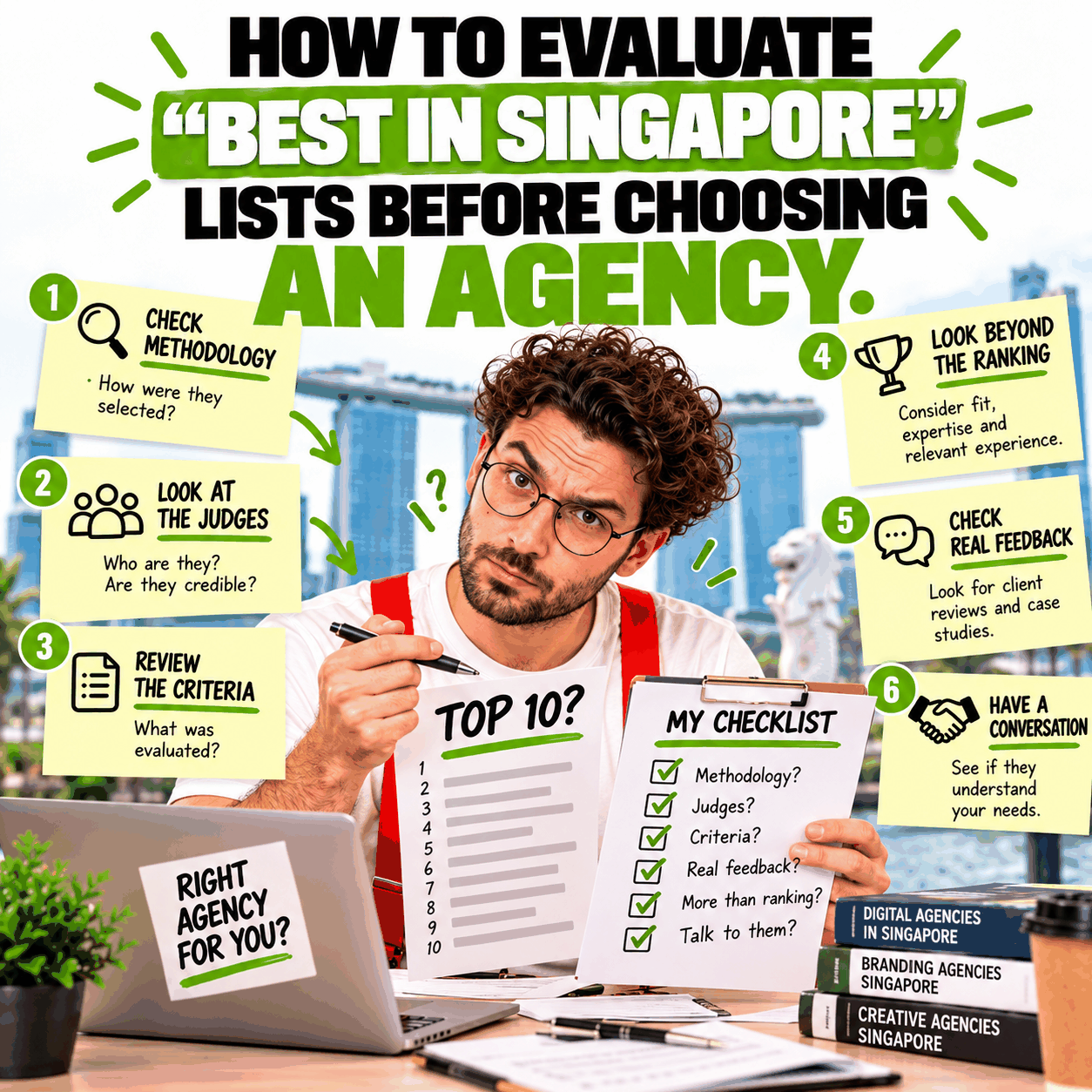
Search for the “best graphic designer in Singapore”, “best branding agency in Singapore”, or “best creative agency in Singapore”, and you will find no shortage of rankings, directories, and recommendation lists.
These lists can provide a useful starting point. However, appearing on a “Best in Singapore” list does not automatically mean that an agency is the right choice for your organisation.
Before relying on any ranking, it is worth understanding how the list was created, what it measures, and whether its recommendations are relevant to the problem you are trying to solve.
The best agency is not simply the one appearing on the most lists. It is the one best equipped to understand your organisation, solve the right problem, and deliver meaningful results.
Why are there so many “Best in Singapore” lists?
Recommendation lists are popular because they make complex purchasing decisions appear simpler. Instead of assessing dozens of agencies, a prospective client is presented with a shortlist of supposedly suitable choices.
These lists may be produced for several reasons:
- To provide genuinely useful editorial recommendations
- To attract visitors searching for services
- To generate enquiries or referral leads
- To sell enhanced listings or promotional packages
- To build backlinks and improve search-engine visibility
- To create content around frequently searched keywords
None of these purposes automatically makes a list unreliable. However, they can influence which companies are included, how prominently they appear, and how the recommendations are presented.
1. Find out who created the list
Start by looking at the organisation behind the article.
Is it an established publication, an industry association, a specialist reviewer, a business directory, or a general content website covering everything from restaurants and renovation firms to accountants and advertising agencies?
A platform does not necessarily need to be an industry specialist to produce useful content. However, its familiarity with branding, advertising, and creative services will affect the depth of its evaluation.
Look for an identifiable publisher, editorial team, author, or organisation that takes responsibility for the information presented.
2. Examine the selection criteria
A credible recommendation should explain how the agencies were assessed.
Possible criteria might include:
- Relevant experience and portfolio
- Client reviews and references
- Industry recognition
- Strategic and creative capabilities
- Range and depth of services
- Length of operating history
- Quality of project outcomes
- Professional credentials or certifications
Be cautious when a list praises every company in broad terms but provides little explanation of how one agency differs from another.
Statements such as “innovative”, “award-winning”, “trusted”, or “leading” should ideally be supported by examples, evidence, or clearly stated assessment criteria.
3. Check whether placements are commercially supported
Some platforms offer free editorial listings. Others may invite businesses to purchase featured placements, upgraded profiles, awards, badges, backlinks, or promotional packages.
Commercial support is not inherently improper. Many legitimate publications and directories operate through advertising or sponsorship.
The important issue is transparency.
Readers should be able to distinguish between an independently selected recommendation and a commercially promoted placement. Look for labels such as “sponsored”, “featured partner”, “advertorial”, or “promoted listing”.
4. Look beyond the position on the list
Being placed first, fifth, or tenth may have little relevance to your particular needs.
An agency that is suitable for a large consumer campaign may not be the right choice for a corporate identity programme, annual report, stakeholder publication, or public-sector engagement.
Similarly, an agency specialising in digital performance marketing may approach a project very differently from one specialising in brand strategy, editorial design, or integrated campaign development.
Instead of focusing on the ranking position, examine why each agency was included and whether its capabilities match your requirements.
5. Review the agency’s own evidence
A directory description should never replace your own evaluation.
Visit the agency’s website and review:
- Its actual portfolio and case studies
- The types of clients and industries it serves
- The business problems it has addressed
- The quality and consistency of its work
- The people responsible for strategy and delivery
- Its working process and project governance
- Whether its stated capabilities are supported by real examples
Good creative work should not only look polished. It should demonstrate an understanding of audience, context, communication objectives, and implementation requirements.
6. Consider whether the agency diagnoses before it designs
Choosing an agency should not begin with visual style alone.
Before recommending a solution, a capable agency should seek to understand:
- Your organisation’s present situation
- The audience you need to influence
- The business or communication problem
- Existing brand perceptions
- Stakeholder expectations
- Operational and implementation constraints
- The risks of taking action — or doing nothing
An attractive execution based on the wrong diagnosis can still be the wrong solution.
Clarity should come before creativity. The agency should understand what needs to change before deciding what needs to be designed.
7. Assess the agency’s ability to implement
A strong idea is only valuable when it can be applied consistently.
Consider whether the agency can translate its recommendations across the touchpoints relevant to your organisation. These might include brand identity, publications, campaigns, environmental graphics, presentations, digital communications, or stakeholder materials.
Ask how the agency manages:
- Project scope and responsibilities
- Timelines and approval stages
- Stakeholder feedback
- Content and asset requirements
- Quality control
- Final artwork and production
- Future adaptations and brand consistency
The right agency should provide both creative thinking and a reliable pathway from strategy to implementation.
8. Decide what “best” means for your organisation
There is no universally best agency for every organisation, industry, budget, and project.
“Best” might mean:
- Best suited to a specific sector
- Best equipped for a complex stakeholder environment
- Best at combining strategy, writing, and design
- Best able to manage a long-term brand programme
- Best aligned with your organisation’s working style
- Best able to deliver within your operational constraints
A useful selection process therefore begins by defining what success looks like for your organisation — not by accepting someone else’s definition of “best”.
A practical agency evaluation checklist
Before appointing an agency, ask the following questions:
- Does the agency understand our business and communication challenge?
- Can it explain its recommendations clearly?
- Does its portfolio demonstrate relevant experience?
- Can it connect creative work to organisational objectives?
- Does it have a structured process for stakeholder input and approval?
- Can it implement the work across the required touchpoints?
- Are responsibilities, deliverables, and costs clearly defined?
- Do we have confidence in the people who will actually manage the work?
These questions will usually reveal more than an agency’s position on any online list.
Choosing with greater clarity
“Best in Singapore” lists can be helpful for discovering agencies you may not already know. They should, however, be treated as the beginning of your research rather than the conclusion.
Check who produced the list. Understand how companies were selected. Look for commercial disclosures. Review the agency’s own evidence. Most importantly, assess whether the agency is equipped to address your organisation’s actual needs.
At JAB Design, we believe an agency should be evaluated by the clarity it brings, the problems it helps solve, and the value its work creates — not simply by the number of online lists on which its name appears.
Our work combines strategic assessment with branding, design, editorial, and campaign implementation. This helps organisations move from an identified need to a clear, practical, and purpose-led creative response.
Explore the JAB Framework to understand how strategy, clarity, and creative execution work together to build meaningful, effective brands.
Choosing an agency? Begin with the problem you need to solve, the outcome you need to achieve, and the capabilities required to take you there.
Related Reading
- Behind The JAB
- Powerful Key Differentiators
- What Our Clients Say
- The JAB Framework
- Do I Need Branding or Just Design?
- How to Brief Your Creative Agency
More About What We Do
Our creative expertise spans four core disciplines:
Need help? Tell us about your project — email us or use our contact form.

