
Design Project Onboarding Checklist
Welcome to JAB
Getting a project started does not mean having every detail worked out from day one. If you are coordinating the project on behalf of your organisation, just share what you know and what you already have.
We’ll take it in two stages — first the essentials, then the materials needed for creative work.
You don’t need to complete everything at once, and not everything below will apply to every project.
Need help shaping the brief? Here’s a simple guide — How to Brief Your Creative Agency.
Stage 1 — Tell us about your project
Start with the basics
A few essentials are enough for us to understand the project and what needs to happen next.
1. What are we creating?
Tell us what you need us to design or develop.
For example:
- Annual report or publication
- Brochure or marketing collateral
- Campaign materials
- Signage or environmental graphics
- Presentation
- Digital or interactive materials
- Something else
If the exact scope is still being worked out, that’s fine.
2. Who is it for?
Who will see, read, use, or interact with the work?
This could be customers, employees, residents, students, parents, stakeholders, investors, partners, or the general public.
3. What should we know about the project?
Give us a short background in your own words.
For example:
- What prompted the project?
- Is there something particularly important your management or team wants to achieve?
- Is there anything we should be careful not to change or overlook?
A short explanation is enough at this stage.
4. What do you already have?
Let us know what materials are already available.
For example:
- Draft or final text
- Logos
- Brand guidelines
- Photographs
- Illustrations
- Charts or data
- Previous artwork
- Reference materials
Don’t worry about sorting out all the technical details yet.
5. Who is coordinating and approving the project?
Please let us know:
- Your main project contact
- Who will provide feedback
- Who gives the final approval
Where possible, having one person coordinate and consolidate feedback helps keep everyone working from the same information.
6. When is it needed?
Tell us about any important dates, such as:
- Required completion date
- Launch or event date
- Presentation or meeting dates
- Other deadlines that cannot move
That’s enough to get started
Send us what you have.
We’ll review the information, clarify anything that needs discussion, and let you know what else is required before creative work begins.
You do not need to work everything out before speaking to us.
Stage 2 — Prepare for creative work
Now let’s gather what we need
Once we understand the project, the next step is to prepare the relevant content, assets, and production information.
Not every section below will apply to your project. We’ll guide you on what is needed.
Content
Where applicable, please provide the latest available:
- Written content
- Names and titles
- Captions
- Contact information
- Tables, charts, or data
- Mandatory statements or information
- Different language versions
Please let us know which items are final and which are still pending.
Logos and brand materials
Please provide any available:
- Logo files
- Brand guidelines
- Corporate identity materials
- Colour specifications
- Existing artwork or templates
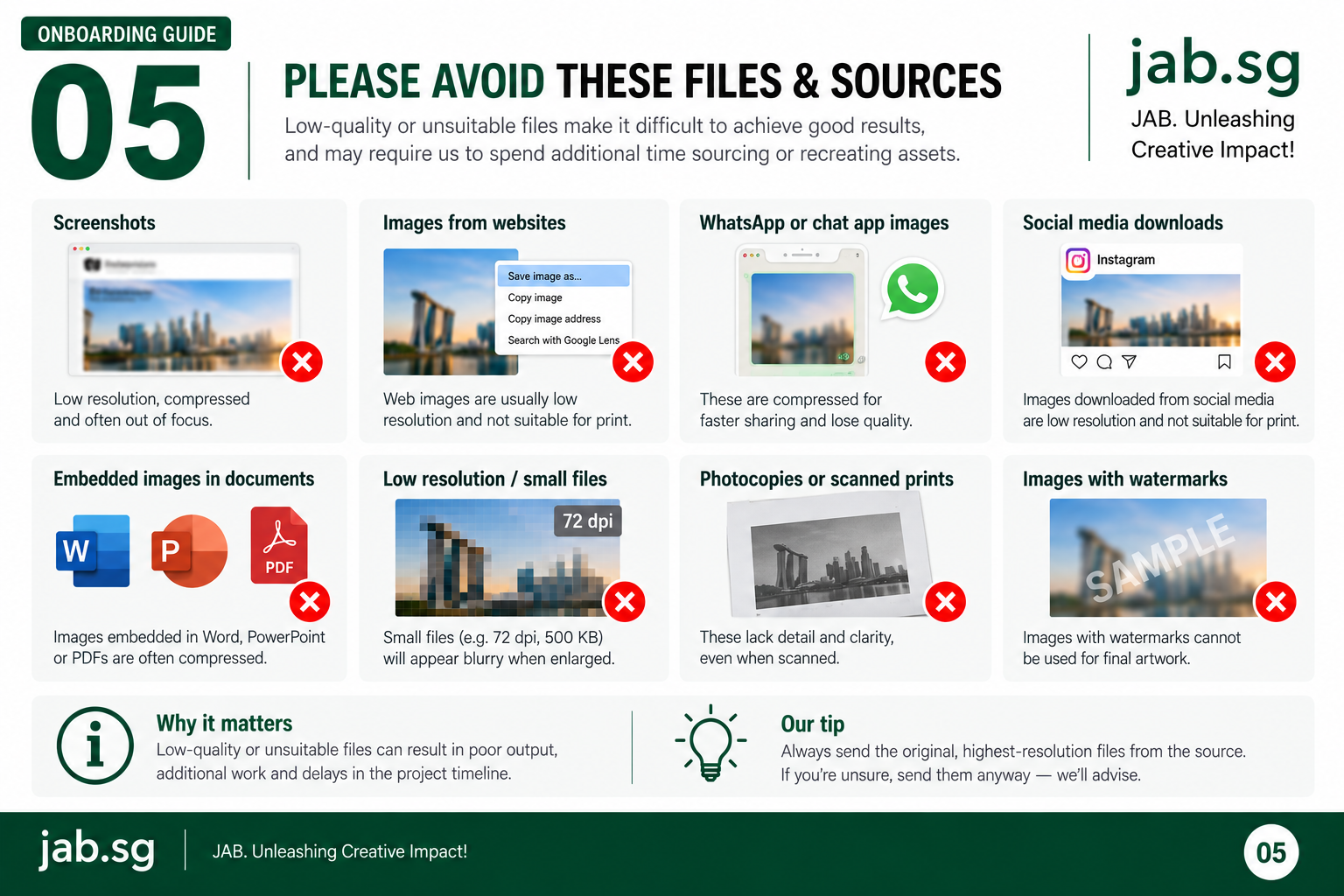
Where original files are available, please send those rather than images copied from websites, Word documents, or PowerPoint slides.
Images and illustrations
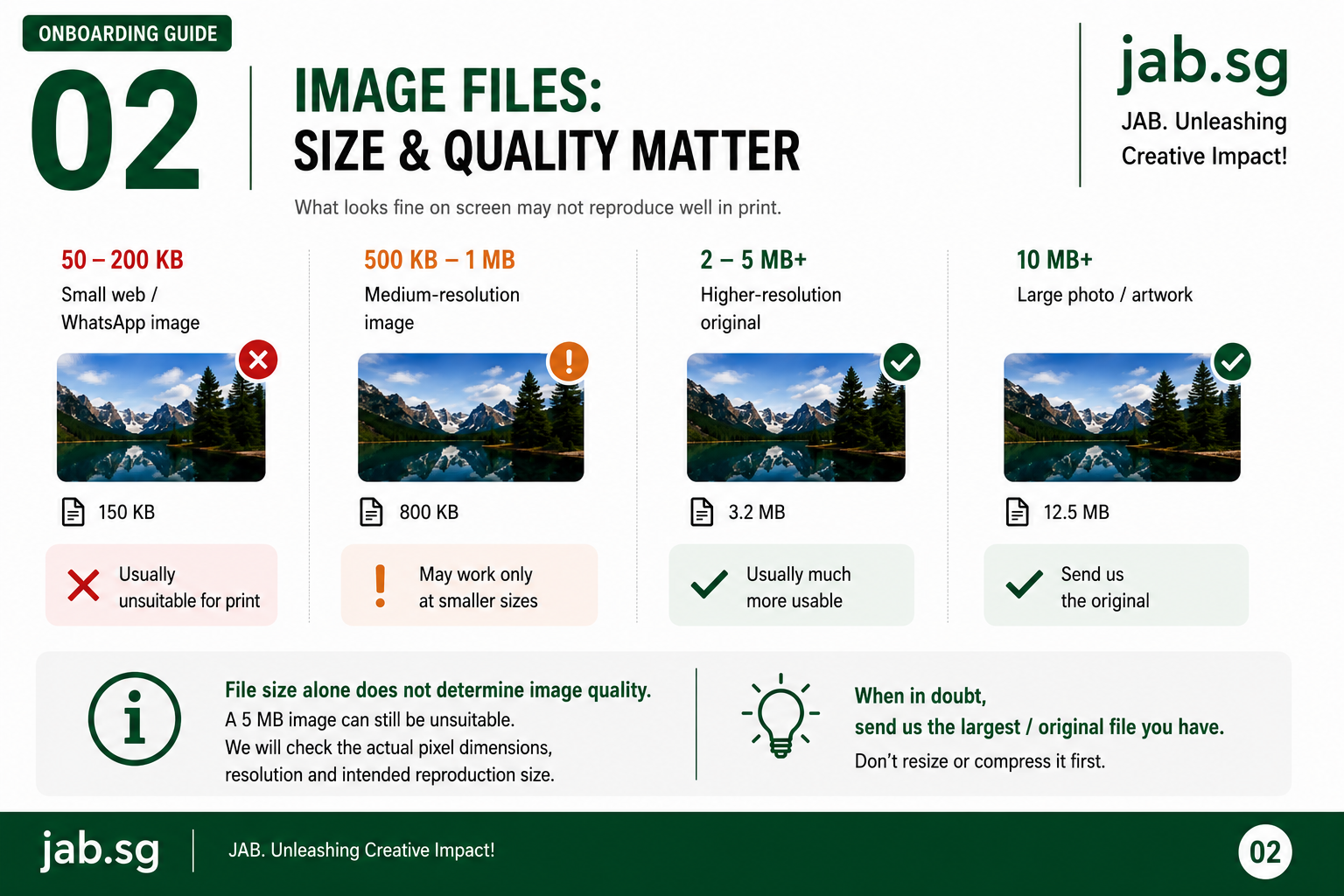
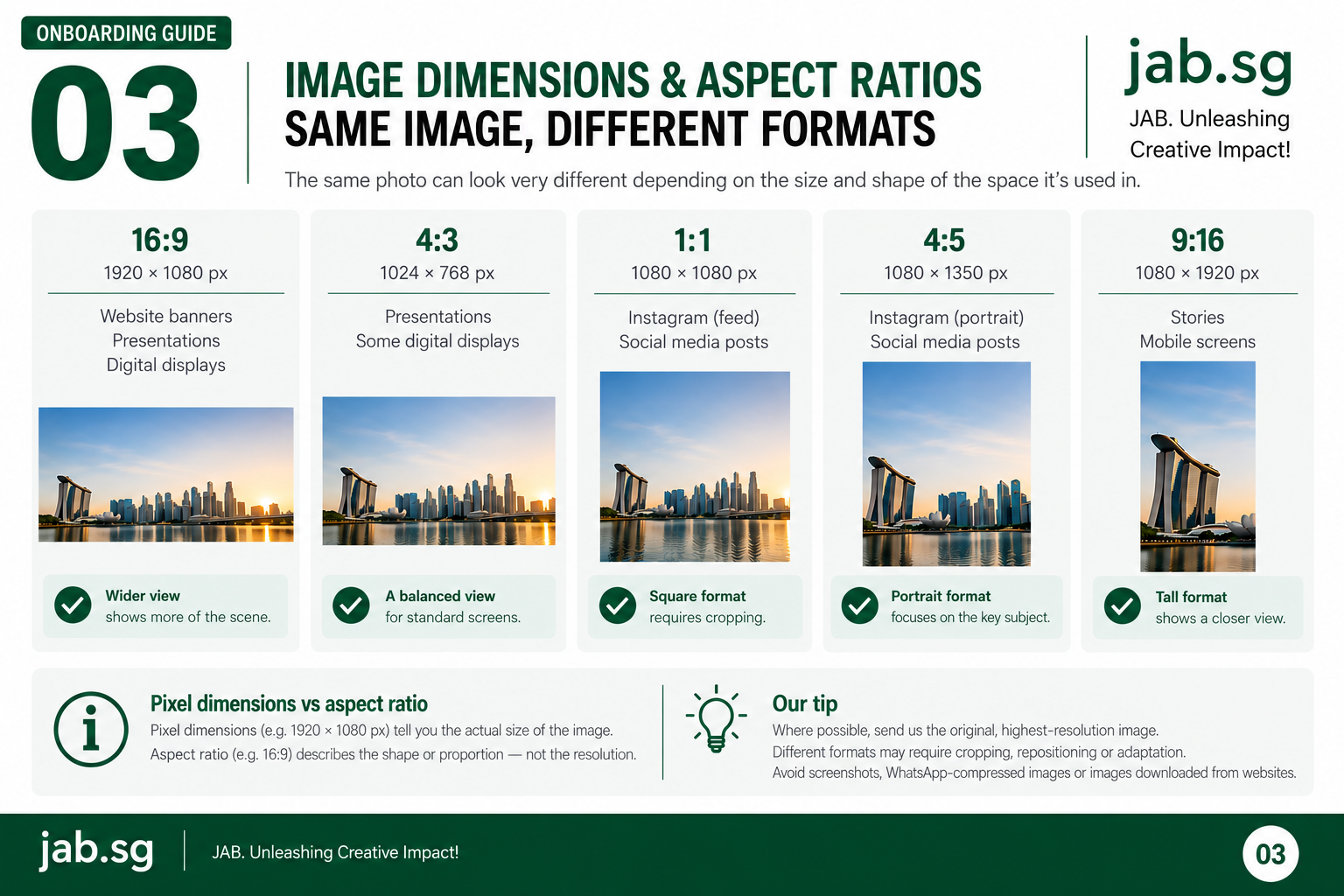
Please provide the best-quality original files available.
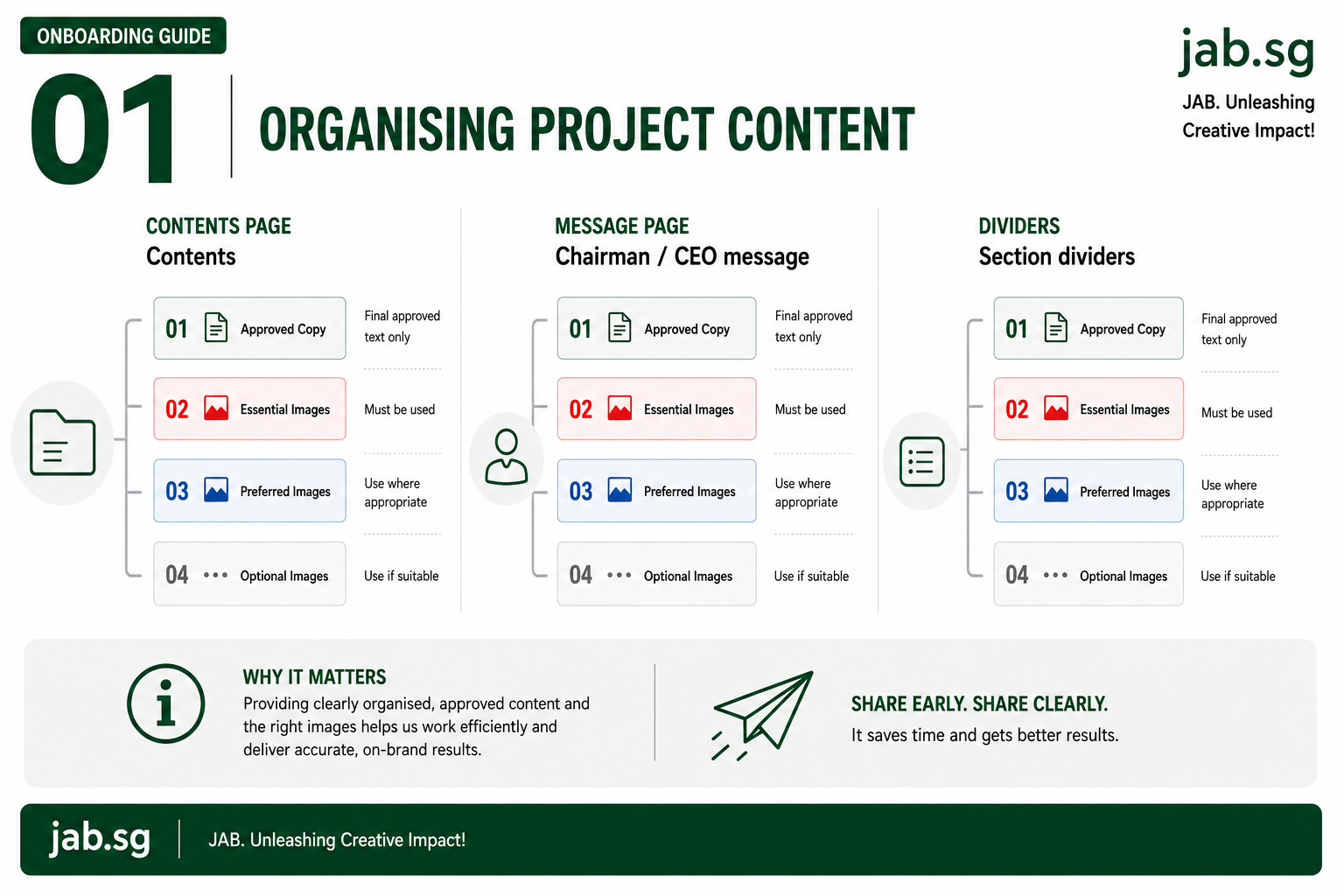
If several photographs or illustrations are supplied, it can help to indicate which are:
- Essential — must be used
- Preferred — use where appropriate
- Optional — use if suitable
Where final content or images are still pending, JAB may use dummy text (Lorem Ipsum) or image placeholders during the design process. This allows the design and layout to progress while clearly identifying items that require replacement before final artwork is approved.
For print and production
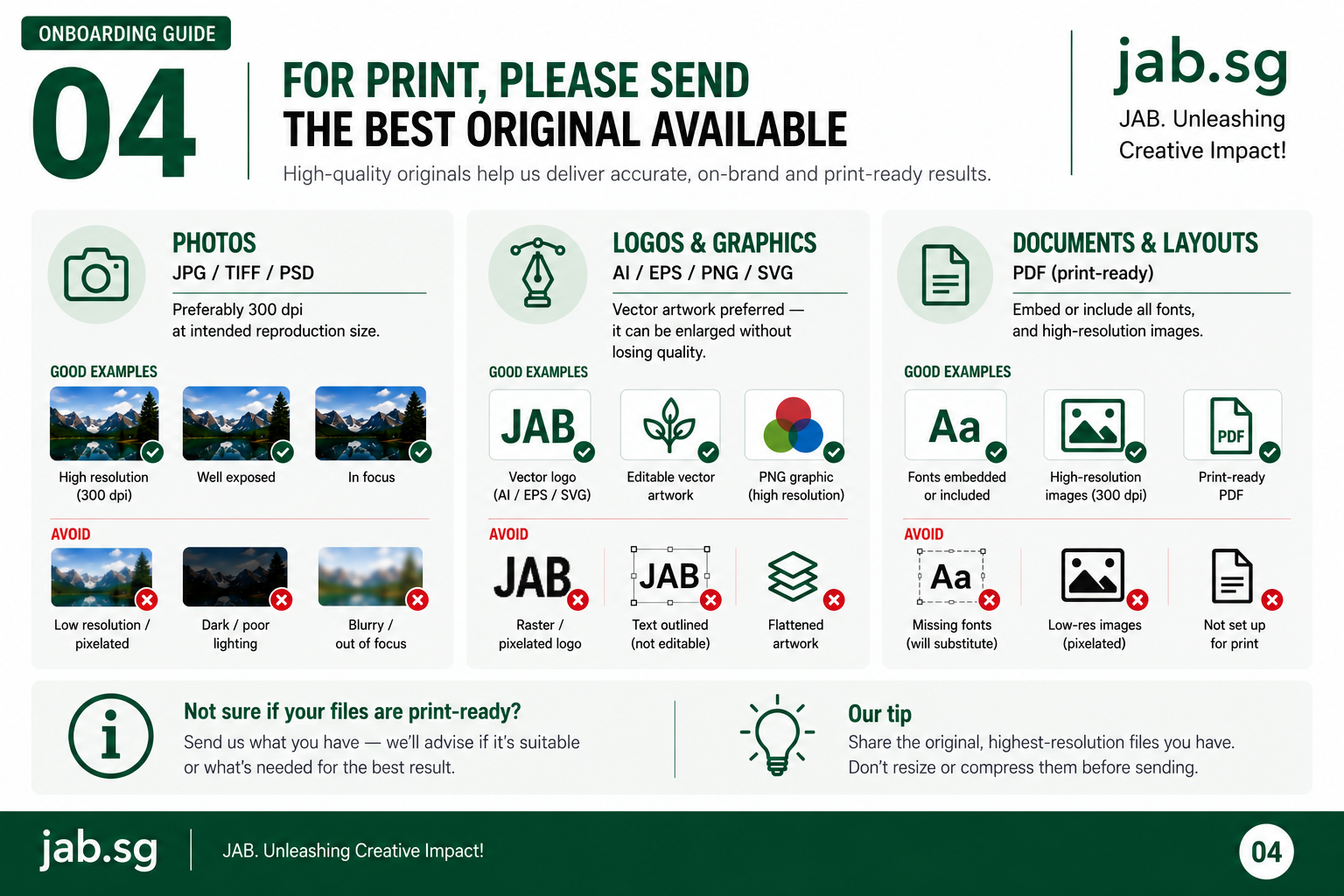
For printed materials, please send the best original files available. High-quality originals give us more flexibility and help us achieve better reproduction.
Colour
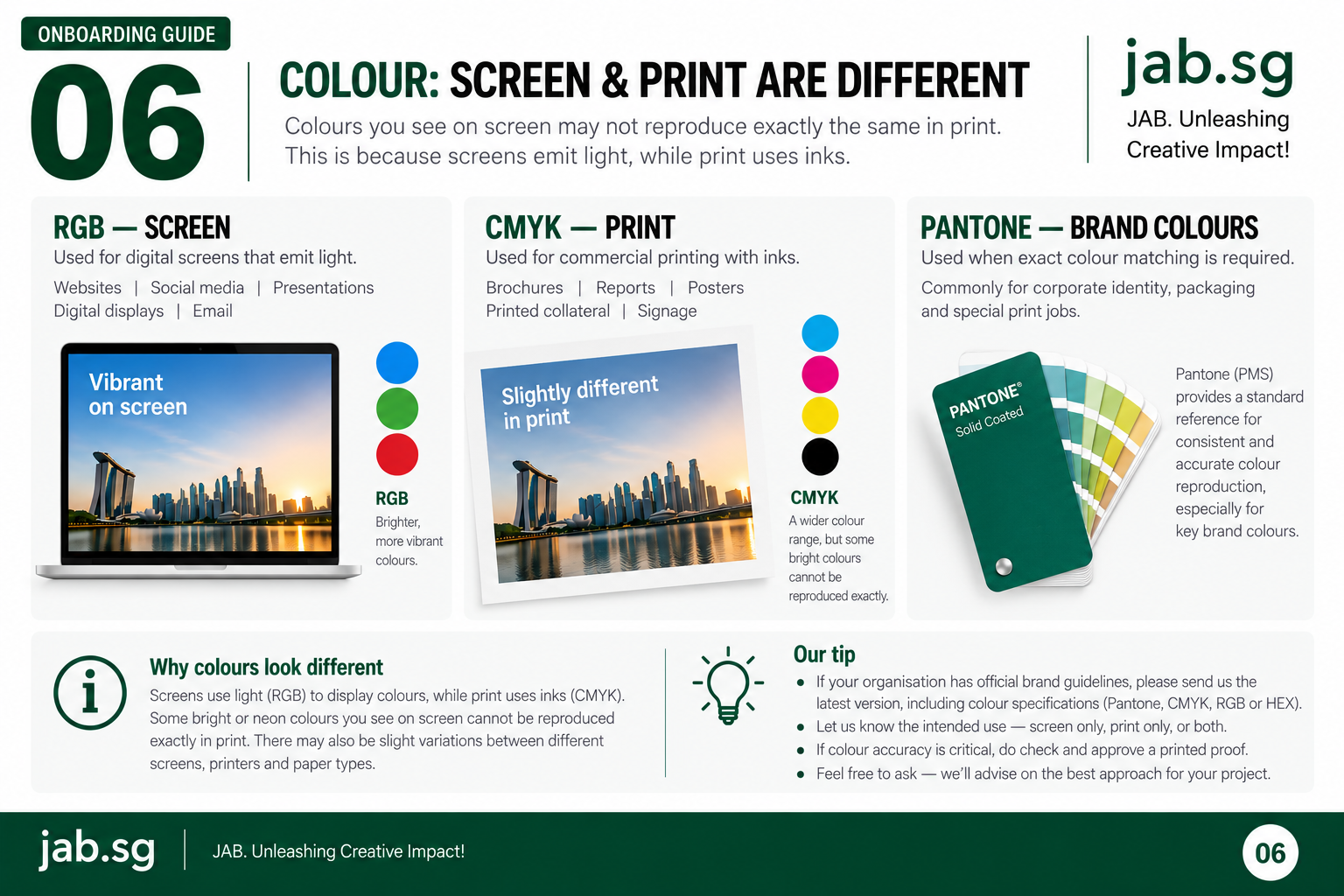
If you’re supplying existing logos, brand assets, or artwork, please include any available colour specifications or brand guidelines.
This is particularly important where accurate brand colour reproduction is required.
Production requirements
Depending on the project, we may also need information such as:
- Final dimensions
- Print specifications
- Digital formats
- Required versions or sizes
- Language adaptations
- Corporate or regulatory requirements
If you are unsure about any of these, please ask. We’ll advise you on what is relevant to your project.
Reviewing artwork
Our preferred method is to comment directly on the PDF supplied by us. Where several people are reviewing, please consolidate feedback into a single marked-up PDF to minimise conflicting instructions and unnecessary revisions.
Sending your files
For larger project files, WeTransfer is our preferred method. If your organisation uses an approved corporate file-sharing platform or has particular security requirements, just let us know.
Please note: For WeTransfer, copy the download link and send it to us directly by email. We do not act on its automated email notifications.
What happens next?
Once we have the relevant materials, we’ll review everything, clarify anything needed, and move into creative development.
Ready to get started? Download the three-page fillable Project Onboarding Form to complete digitally or print and annotate, then email your responses to JAB Design.
Thank you
Thank you for choosing JAB Design. If you have any questions at any stage, please get in touch — we’re here to help.
Related Reading
- AI vs .AI Files: Why Your Printer Isn’t Asking for Artificial Intelligence
- RGB vs CMYK: Why Colours Look Different on Screen and in Print
- How to Create an Eye-Catching Infographic
More About What We Do
Our creative expertise spans four core disciplines:
Need help? Tell us about your project — email us or use our contact form.

