
Enterprise Development Grant (EDG): A Practical Guide for Branding & Marketing Projects
Thinking of using the Enterprise Development Grant (EDG) for a branding or marketing project?
This guide explains the Enterprise Development Grant (EDG) framework as it applies before Singapore’s transition to the new EDGE Grant on 30 September 2026.
It focuses particularly on Strategic Brand and Marketing Development under Enterprise Singapore and is intended to help business owners make better strategic decisions — not simply to maximise grant funding.
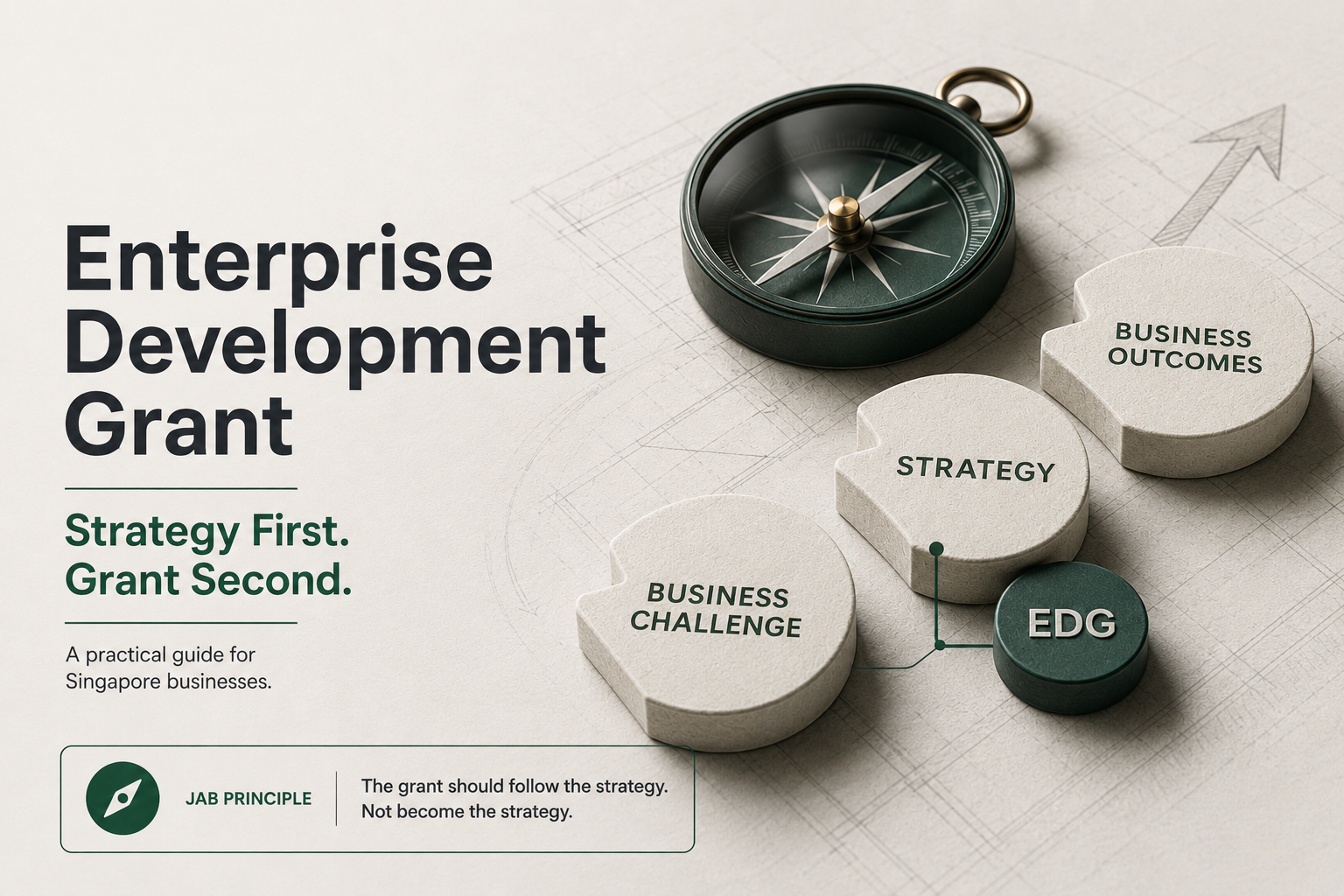
Start with the business need.
The right grant follows the right business objective — not the other way around.
EDG transition update — September 2026
The Enterprise Development Grant is entering its final stage as a standalone grant scheme.
EDG, the Productivity Solutions Grant (PSG), and the Market Readiness Assistance (MRA) Grant cease on 29 September 2026.
From 30 September 2026, businesses seeking new grant support should explore the new unified EDGE Grant.
At the same time, the new BizSG initiative provides businesses with a simpler way to discover relevant government support based on their company profile, business plans, and intended activities.
Existing EDG, PSG, and MRA submissions and projects do not simply disappear.
Enterprise Singapore has stated that ongoing submissions and projects will continue to be processed, and claims may still be submitted upon project completion.
If you are considering a new project from 30 September 2026, read our EDGE Grant Singapore guide.
If you already have an EDG application or approved EDG project, the information below remains useful as a reference to the framework under which your project was developed.
About the Enterprise Development Grant
The Enterprise Development Grant (EDG), administered by Enterprise Singapore, supports projects intended to help Singapore businesses upgrade, innovate, grow, and transform.
EDG funds individual projects based on the applicant’s business plans and intended project outcomes.
Qualifying project costs may include:
- Third-party consultancy fees
- Software and equipment
- Internal manpower costs
The actual costs supported depend on the approved project category, project scope, and conditions stated in the applicant’s Letter of Offer.
How EDG projects are structured
EDG projects fall under three broad categories:
- Core Capabilities
- Innovation & Productivity
- Market Access
For businesses considering branding and marketing transformation, the relevant project area has been Strategic Brand and Marketing Development under Core Capabilities.
Its purpose is not simply to subsidise creative production.
It is intended to help businesses strengthen their foundations, develop clearer strategies, and improve their ability to compete and grow.
What could Strategic Brand and Marketing Development cover?
Under the EDG framework, potentially supportable strategic work may include:
- Business diagnosis and gap analysis
- Customer, market, and competitor research
- Assessment of internal and external business factors
- Primary or secondary research
- Brand positioning and value proposition development
- Brand strategy and differentiation
- Development of a differentiated proposition against competitors
- Assessment of brand value and identification of brand levers
- Strategic marketing and customer communications planning
- Strategic recommendations and implementation planning
These activities should address a genuine business need and contribute towards meaningful capability development.
A strategic branding project should establish what the business stands for, whom it must reach, and how it can compete more effectively.
Creative execution follows from that clarity.
Strategy is not the same as creative production
One of the most common misconceptions about the EDG has been that it automatically subsidises the production of logos, brochures, websites, videos, or digital marketing campaigns.
It does not.
Under Strategic Brand and Marketing Development, Enterprise Singapore distinguishes strategic consultancy from the subsequent production and implementation of marketing materials.
Activities listed as not covered under this EDG project area include:
- Production of corporate or marketing collateral
- Brochures
- Videos
- Websites
- Photography and stock images
- Copywriting
- Implementation of marketing or public relations campaigns
- Consultant retainer fees for campaign implementation
- Advertising and media buys
- Engagement of social media influencers
- Management of websites or social media platforms
- Search engine optimisation
- Search engine marketing
These activities may still be necessary to implement a strategy. They should not, however, be assumed to qualify as strategic consultancy costs merely because they form part of a branding or marketing project.
The EDG may support the thinking and strategy behind business transformation.
It does not automatically fund everything subsequently designed, produced, or promoted.
A logo is not the business objective
A prospective client may initially tell us:
“We need a new logo.”
“We need a website.”
“We want a corporate brochure.”
These are outputs — not business objectives.
The underlying business challenge may instead be that:
- The organisation has outgrown its original positioning
- Customers do not clearly understand its value proposition
- Different business units communicate inconsistently
- The brand no longer reflects the organisation’s capabilities
- The company is preparing to reach a different audience or market
- The organisation needs a clearer structure for future growth
A properly scoped engagement begins by defining the business challenge before deciding what should eventually be designed or produced.
Is a strategy-led project the right starting point?
An organisation may be ready for a strategy-led engagement when:
- It has identified a genuine business challenge or opportunity
- It wants to strengthen its brand and competitiveness
- It is prepared to invest in meaningful business transformation
- It sees branding as part of wider business strategy
- It is looking for objective diagnosis and strategic advice
- It is prepared to implement the recommended strategy properly
A business may need to reconsider its approach if:
- Its main objective is simply to obtain the highest possible subsidy
- It is looking primarily for a cheaper logo, website, or marketing campaign
- The project only makes commercial sense if it is subsidised
- Branding is viewed only as a one-off design exercise
- It is looking for someone to “get us the grant”
- Routine production work is being packaged as strategic consultancy
If you are looking for the biggest grant, we are probably not your first call.
If you are looking to build a stronger business, we would be pleased to have a conversation.
Basic EDG eligibility
Under the EDG framework, applicants are required to:
- Be a business entity registered and operating in Singapore
- Have at least 30% local equity held directly or indirectly by Singapore Citizens or Permanent Residents
- Be financially ready to start and complete the project
Meeting the basic eligibility criteria does not guarantee grant approval.
Applications are assessed according to factors including the applicant, project scope, intended outcomes, project merits, and the competency of the appointed service provider.
Eligibility is not the same as approval.
How much EDG support was available?
Under the prevailing EDG framework before the transition to EDGE, eligible local SMEs may receive support of up to 50% of qualifying project costs.
Support levels can differ for particular initiatives or project categories and may change over time.
Businesses with an existing EDG application or project should therefore refer to their application, Letter of Offer, and the prevailing Enterprise Singapore requirements applicable to that project.
Are there “EDG-approved” agencies?
No consultant certification or service provider appointment guarantees EDG approval.
Every application is evaluated according to the applicant’s eligibility, project scope, extent of capability development, project merits, deliverables, intended outcomes, and expected impact on the company.
Businesses should therefore be cautious of anyone who:
- Claims that grant approval is guaranteed
- Focuses primarily on maximising the subsidy
- Suggests disguising production costs as consultancy fees
- Describes ordinary creative production as business transformation without a credible strategic scope
- Pressures the company to proceed before the requirements are understood
A credible consultant can help define and document an appropriate project.
No consultant can decide whether Enterprise Singapore will approve it.
Does the consultant need to be certified?
For EDG projects involving management consultancy services, the individuals performing the consultancy work are required to possess an Enterprise Singapore-recognised management consultant certification.
Management consultancy may include activities such as:
- Gathering and analysing relevant information
- Diagnosing business or operational issues
- Designing appropriate solutions
- Recommending actions to improve company performance
Recognised management consultant certifications have included:
- Practising Management Consultant (PMC)
- Singapore Certified Management Consultant
- Registered Management Consultant
The requirement applies to the individual providing management consultancy — not merely to the firm named in the proposal.
Other specialists undertaking functions such as research fieldwork, design, or technical implementation may have different requirements where they are not themselves providing management consultancy.
Certification is an assessment requirement. It is not an assurance that a particular project will receive grant approval.
Who submits an EDG application?
For applications made under the EDG framework before the transition, the applicant company submits its own grant application using its authorised corporate access.
A consultant may help the company:
- Clarify the underlying business challenge
- Develop an appropriate project scope
- Define strategic objectives and outcomes
- Prepare the supporting consultancy proposal
The applicant remains responsible for providing accurate company and financial information, submitting the application, and complying with the applicable grant requirements.
The consultant develops the consultancy engagement.
The business remains responsible for its grant application.
When could an EDG project begin?
Under the EDG framework, a proposed project must be new and must not have commenced before the grant application is submitted.
Before submission, businesses should not begin project work, make payment to a consultant or service provider included in the application, or enter into a contractual commitment relating to the proposed project.
Submitting an application does not mean support has been approved.
Businesses should refer to the prevailing Enterprise Singapore requirements and their Letter of Offer before commencing an approved EDG project.
For existing approved projects, the Letter of Offer sets out the approved scope, qualifying period, deliverables, conditions of support, and grant amount.
How are EDG claims paid?
EDG generally operates on a reimbursement basis.
The applicant finances and completes the approved project before submitting its claim with the required evidence.
Supporting documentation may include:
- A project report
- Evidence that approved deliverables have been completed
- Invoices
- Bank statements or other proof of payment
- Supporting employment or appointment documents where applicable
- Other verification or audit documentation where required
For ongoing EDG projects, Enterprise Singapore has confirmed that claims may continue to be submitted upon project completion after the transition to EDGE.
What happens to existing EDG applications and projects?
The transition to EDGE does not mean that existing EDG projects are cancelled.
Enterprise Singapore states that ongoing EDG submissions and projects will continue to be processed.
Businesses with an existing EDG project should therefore continue to follow:
- The scope approved for their project
- The conditions in their Letter of Offer
- The approved project period
- The required deliverables
- The applicable claims and supporting document requirements
The transition mainly changes the framework for new grant support from 30 September 2026.
What replaces EDG?
From 30 September 2026, EDG, PSG, and MRA are replaced by the unified EDGE Grant for new business grant support.
EDGE brings support previously spread across the three schemes into a single framework.
Businesses can also use the new BizSG initiative to discover government support relevant to their company profile, business plans, and intended activities.
This EDG page is therefore retained as a reference for the former EDG framework and for organisations with existing EDG applications or projects.
For new projects, see:
EDGE Grant Singapore: What the New Unified Grant Means for Branding & Marketing Projects
The grant framework may change.
The need for clear business thinking does not.
How JAB Design supports strategy-led projects
At JAB Design, branding begins with understanding the business — not with a predetermined list of creative deliverables.
Our strategic work is led by an SBACC-certified Practising Management Consultant and combines structured management consultancy with brand strategy and, where required, subsequent creative implementation.
Depending on the organisation’s needs, a strategy-led engagement may include:
- Business and brand diagnosis
- Stakeholder consultation
- Customer, market, and competitor assessment
- Brand positioning
- Value proposition development
- Brand architecture
- Strategic messaging
- Marketing and communications planning
- Recommendations and implementation roadmap
Where design, content, or production is subsequently required, strategic consultancy and creative implementation should be clearly distinguished and appropriately scoped.
We do not structure projects merely to maximise grant funding, and we cannot guarantee or influence the outcome of a grant application.
Our role is to help organisations determine what the business needs, develop an appropriate strategy, and translate that thinking into effective communication and creative implementation where required.
We help organisations define the right strategy first — because effective creative work must be built on clear business thinking.
Before contacting JAB Design
To make the best use of everyone’s time, organisations considering a strategy-led engagement should be prepared to discuss:
- The business problem or opportunity being addressed
- Why the project is necessary now
- What has changed within the organisation or market
- Who the intended customers and stakeholders are
- How the organisation currently differentiates itself
- What measurable outcomes it expects
- What resources it is prepared to commit
- How the resulting strategy will be implemented
Our conversations begin with “What business problem are we solving?” — not “How much grant can we get?”
Official EDG and EDGE resources
Grant schemes, eligibility conditions, application requirements, and support levels may change.
Businesses should always refer to Enterprise Singapore’s latest information before making financial or project commitments.
- Enterprise Development Grant (EDG) — Enterprise Singapore
- Enterprise Development Grant FAQs — Enterprise Singapore
- EDGE Grant — Enterprise Singapore
- BizSG announcement — Enterprise Singapore
Information on this page was reviewed in September 2026 and is provided as a general guide. It does not constitute grant, legal, financial, or approval advice. Enterprise Singapore’s prevailing requirements and the conditions applying to an individual application or Letter of Offer take precedence.
Clarity first — then action
A successful brand transformation should not begin with the question:
“What can we get funded?”
It should begin with:
“What does our organisation need to achieve?”
That principle applied under EDG and remains relevant as Singapore moves to EDGE.
A grant should accelerate a well-conceived strategy.
It should never become the strategy.
Learn more about the JAB Framework and how we help organisations move from business clarity to strategic and creative action.
If you are considering a strategy-led branding, design, or communications project, we’d be pleased to hear from you.
Email us at info@jab.sg, or connect with us via our contact form.
Related Reading
- EDGE Grant Singapore
- The JAB Framework
- Identity & Branding
- How to Brief Your Creative Agency
- Meet Our Practising Management Consultant (PMC)
More About What We Do
Our creative expertise spans four core disciplines:
Need help? Drop us an email at info@jab.sg, or connect with us through our contact form.

