
Road Safety for the Elderly: An Islandwide Public Awareness Campaign
Campaign Development & Management · Public Awareness Communication · Environmental & Graphic Design · Digital Media

At a glance
Taking road-safety messages beyond conventional media and into the environments where everyday behaviour happens.
Road safety involving elderly pedestrians has long been an important public concern in Singapore.
As part of ongoing road-safety efforts, the campaign addressed the behaviours surrounding elderly pedestrians — encouraging seniors to cross safely, reminding motorists to look out for vulnerable road users, and encouraging the wider public to assist elderly pedestrians where needed.
JAB Design supported the campaign by developing and applying a coherent visual communication approach across multiple public-facing touchpoints.
The challenge
Road safety is not simply an information problem. It is a behavioural one.
The communication had to speak to several audiences whose actions intersect at the same moment on the road.
- Elderly pedestrians — encouraging safer crossing habits and greater awareness when navigating roads.
- Motorists — reminding drivers to slow down, stay alert and look out for elderly and other vulnerable road users.
- The wider public — encouraging younger and able-bodied members of the community to be more aware of elderly pedestrians and assist them when necessary.
One road-safety issue. Different audiences. Different behaviours. One coherent communication system.
Designing around behaviour
The campaign communication needed to do more than raise general awareness.
It had to place relevant messages where different audiences could encounter them naturally — while driving, travelling through neighbourhoods, attending community roadshows, using public spaces or encountering campaign information online.
This meant thinking beyond individual posters or advertisements and considering how the same campaign message could work across different environments, formats and moments of attention.
Audience → Behaviour → Message → Touchpoint → Repetition
This provided the basis for an integrated public-facing communication approach.
Taking the message into everyday environments
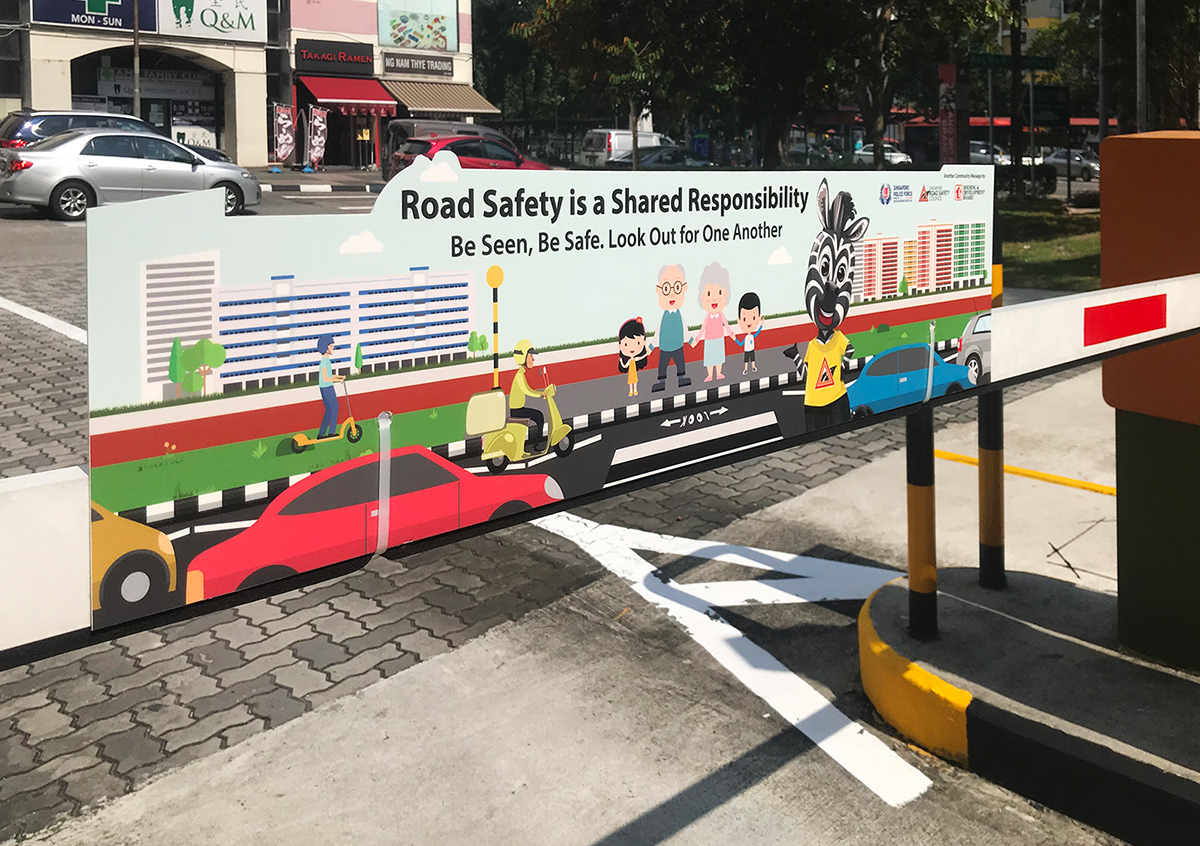
One of the campaign’s most distinctive applications brought the road-safety message directly to motorists.
As part of the Traffic Police initiative, with support from the Housing & Development Board and Singapore Road Safety Council, road-safety messages were deployed across 400 drop-arm barriers at HDB carparks.
Rather than relying only on conventional advertising spaces, the barriers created a communication opportunity at precisely the point where motorists were entering and exiting residential carparks — environments shared with pedestrians, including elderly residents.
The environment itself became part of the communication strategy.
The campaign message therefore appeared not only where people might read about road safety, but where motorists were actively driving and making decisions.
Static, moving and digital touchpoints
The communication extended well beyond the HDB carpark barriers.
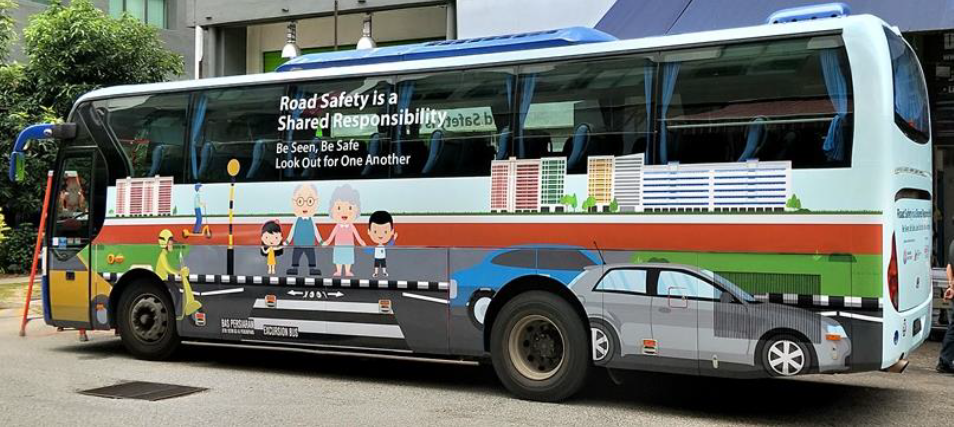
Full-body graphics were applied to school buses, turning moving vehicles into highly visible campaign touchpoints travelling through neighbourhoods and public spaces.
The same messaging was carried through:
- HDB carpark entrance and exit barriers
- Full-body school bus graphics
- Campaign posters
- Pamphlets and educational materials
- Roadshow communications
- Digital media
Each format performed a different communication role, but all reinforced the same underlying road-safety messages.
This consistency helped the campaign maintain recognition as it moved between physical environments, community engagement and digital communication.
Communicating with multiple audiences
The breadth of the campaign was important because road safety involving elderly pedestrians cannot be addressed by speaking only to the elderly.
For seniors, the communication reinforced safer pedestrian behaviour, including the importance of using designated crossings and making themselves visible to motorists.
For motorists, the message focused attention on vulnerable road users and the need for greater care, particularly within neighbourhood environments.
For the wider community, the campaign encouraged greater awareness and a willingness to assist elderly pedestrians when needed.
The communication connected individual responsibility with a shared public outcome: safer roads for everyone.
A campaign designed for repeated exposure
Public-awareness communication rarely depends on a single encounter.
By applying a consistent visual and messaging system across numerous touchpoints, the campaign created opportunities for repeated exposure in different contexts.
A motorist could encounter the message at an HDB carpark.
A pedestrian could encounter it on a passing school bus.
A family could encounter it through a poster, pamphlet or community roadshow.
The same message could then be reinforced through digital media.
Instead of treating each application as an isolated piece of design, the campaign worked as a connected communication system.
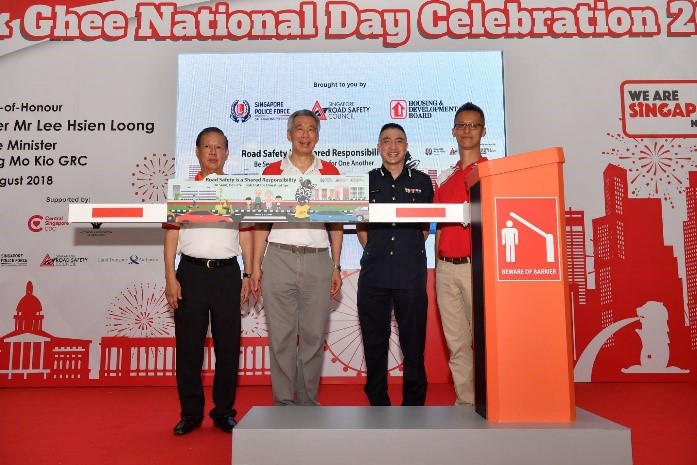
Road Safety Carnival for Seniors and Families, held in conjunction with Teck Ghee’s National Day celebration on 11 August 2018, graced by then-Prime Minister Lee Hsien Loong (2nd from left) as Guest-of-Honour.
Public engagement
The HDB carpark barrier initiative was presented at the Road Safety Carnival for Seniors and Families on 11 August 2018, where then-Prime Minister Lee Hsien Loong attended as Guest-of-Honour.
The event formed part of broader efforts by the Singapore Road Safety Council and its partners to raise road-safety awareness among seniors, families, motorists and the wider community.
The physical barrier application demonstrated how campaign communication could move beyond conventional media and become part of the everyday road environment itself.
Design with public purpose
The project demonstrates the role design can play in translating an important public issue into communication that works across audiences, environments and media.
Public issue → Audience behaviours → Communication strategy → Visual system → Multiple touchpoints → Repeated exposure
The road-safety initiative was driven by the relevant public agencies and road-safety organisations. JAB Design supported those efforts through the development and application of campaign communications across an extensive range of public-facing touchpoints.
Across carpark barriers, moving buses, posters, pamphlets, roadshows and digital media, the objective remained consistent: to make an important road-safety message visible, understandable and relevant wherever its audiences encountered it.
Explore Our Case Studies
Identity & Branding
Food from the Heart — Clean Plate Campaign
Graphic, Interactive & Environmental Design
Singapore Airlines — Service Standards
Copywriting, Editorial & Publishing
Singapore Memory Project — Memory Kit
Campaign Development & Management
Road Safety for the Elderly
More About What We Do
Our creative expertise spans four core disciplines:
Need help? Tell us about your project — email us or use our contact form.

